Are you curious about starting a rose garden but unsure where to begin? Many people feel overwhelmed by the thought of growing roses. They worry it’s too hard or time-consuming.
Did you know that with the right tips, anyone can grow beautiful roses? It doesn’t matter if you’re a beginner or have some experience in gardening. You just need the right guidance.
In this guide, you’ll learn about different types of roses, their benefits, and how to handle any challenges. You’ll get practical tips for making your rose garden thrive. Keep reading to become a rose expert!
A rose garden can be formal, cottage-style, or modern, and each type offers beauty, fragrance, wildlife value, and year-round interest if planned well. The main trade‑offs are maintenance needs, susceptibility to pests and diseases, and the requirement for good soil, sun, and regular pruning.
This rose garden often has symmetrical beds, straight paths, clipped hedges, and structures such as pergolas, arbors, and obelisks.
Often feature hybrid tea and floribunda roses in rows or geometric patterns for a very structured, classic look.
This rose garden is typically Informal, romantic planting that mixes shrub and English roses with perennials such as foxgloves, hollyhocks, nepeta, and phlox.
Uses fragrant, full‑petalled English roses to spill over paths, walls, and fences, creating soft, overflowing borders.
Roses combined with ornamental grasses, shrubs, and perennials in looser designs rather than rose‑only beds.
Climbing roses on walls or archways, or compact varieties in containers, suit small or urban gardens and balconies.
Roses provide long flowering seasons, a wide color range, and strong fragrance that can structure the whole garden design.
Research on rose landscapes shows visual exposure to rose plantings can lower stress and improve mood and attention, especially with carefully chosen colors and scents.
Gardening and tending plants is associated with reduced anxiety, better mood, and improved cognitive function, and roses act as a particularly evocative focal plant.
Sensory engagement with blooms and fragrance can support emotional regulation and attention restoration after mentally demanding tasks.
Flowering roses attract pollinators and beneficial insects, especially when mixed with other nectar‑rich plants.
Shrub and hedge roses can provide structure, screening, and habitat in addition to flowers.
Roses are prone to aphids, spider mites, thrips, and scale, which can weaken plants or damage buds and foliage.
Fungal problems such as black spot, powdery mildew, and rust are frequent, especially in damp, poorly ventilated conditions, and may require pruning and targeted fungicide use.
In a rose garden, many traditional roses need annual pruning, deadheading, feeding, and regular deep watering, particularly in the first year and in hot or dry climates.
Poor spacing and lack of airflow lead to more disease, so gardens must be planned with adequate distance between plants, usually at least 60–90 cm apart.
A rose garden generally need full sun and well‑drained, fertile soil; heavy shade or waterlogged ground will compromise flowering and health.
Highly formal layouts can look sparse in winter unless combined with evergreen structure and underplanting.
Select a position with at least 6 hours of direct sun and good air circulation, away from overhanging, dense trees.
Improve soil with organic matter, ensuring it drains well but retains moisture; avoid replanting new roses directly into soil where old roses recently grew without soil renewal.
When planting, spread roots, back‑fill with soil while firming gently to remove air pockets, water thoroughly, then top up soil as it settles.
For newly planted roses, trim back to a framework of 2–5 strong canes about 20–30 cm long and remove weak, twiggy growth to encourage vigorous new shoots.
In late winter or early spring, remove dead wood, thin weak stems, and open the center of the plant to create a vase shape with good airflow.
Make pruning cuts 0.5–1 cm above an outward‑facing bud at roughly a 45‑degree angle, then clear away debris and feed to support strong regrowth.
Water deeply but infrequently at the base of plants rather than overhead, mulch to conserve moisture, and keep grass and weeds down to reduce pest habitat.
Monitor regularly for early signs of pests or disease, remove heavily affected material, and encourage natural predators such as ladybirds before resorting to chemicals.
Share the rose garden size, climate, and style you want (formal vs cottage, low‑ or high‑maintenance), a tailored outline for a rose garden could be drafted by a garden center.
Design a formal rose garden around strong symmetry, straight paths, and repeated blocks of the same rose varieties, keeping beds narrow enough for easy access and maintenance. The layout should start from one clear central axis, then build out with matching beds, hedges, and structural features such as arbors, ponds, or statuary.
Decide on a straight line that connects key views, such as from the house to a focal point like a statue, pond, or arbor; this becomes the primary organizing line.
Lay a principal path along this axis in the rose garden and, in many formal layouts, add a secondary path at right angles so the garden forms a cross or grid pattern.
Use a central feature (round bed, pond, sundial, or clipped yew circle, as in the Sissinghurst rose garden) to anchor the layout.
Arrange beds as rectangles, squares, or circles mirrored on both sides of the axis, avoiding irregular shapes to preserve a formal feel.
Set out gravel, stone, or brick paths before planting so movement lines and symmetry are fixed; these should be straight and clearly edged.
Ensure paths are wide enough to walk and work comfortably, and connect all beds so you can prune and deadhead without stepping into planting areas.
Keep individual beds narrow enough to reach the center from a path, so you are not stretching across roses; designers recommend avoiding overly wide beds in formal schemes.
Repeat the same bed shapes and dimensions on both sides of each axis so the garden reads as a series of balanced “rooms” or parterres.
For classic formal layouts, favor hybrid teas, floribundas, and some compact English roses that have tidy growth and regular flowering.
Use standard roses (lollipop forms) at regular intervals along paths or around a central feature to emphasize order and rhythm.
Plant in blocks or drifts of a single variety (often 3–5 plants per block) for strong color and form rather than mixing many varieties in one bed.
As a general guide, small shrub roses are often spaced about 24–30 inches (60–75 cm) apart, each covering roughly 4–6 square feet, while larger shrubs may need 30–36 inches (75–90 cm).
Define bed edges with low clipped hedging such as box or low shrub roses to reinforce straight lines and geometry.
Plant hedge roses a bit closer than normal (for example around 60 cm apart for dense hedges) so they knit into a continuous line.
Position arbors, pergolas, or obelisks on the main axis or at path intersections, then train climbing roses over them to mark entrances and transitions.
Use repeated vertical elements (matching obelisks or standards) to frame views and maintain symmetry from multiple vantage points.
Limit the palette in each formal garden to one or a few harmonizing colors to avoid visual clutter; repeat these colors across mirrored beds.
Place bolder or darker colors towards the center or at focal points, keeping paler shades where you want the space to appear larger or lighter.
Locate the main axis so key vistas from windows or terraces look straight down a path or onto a central feature, not at an angle.
Scale paths, beds, and structures to the size of the garden; small plots can still be formal by using fewer, simpler beds and vertical elements rather than sprawling layouts.
If you describe your garden’s dimensions and sun aspect (for example: 6 m by 10 m, full sun, view from the house on one short side), a simple mirrored layout plan with suggested bed count, path widths, and plant numbers . You can then plan the layout of the rose garden.

Roses come in many types, each offering something unique. Learning about these types will help you pick the best roses for your garden.
In most rose gardens, gardeners group roses into a handful of main types: old garden roses, modern bush roses (like hybrid teas and floribundas), shrub/landscape roses, climbers and ramblers, groundcover roses, and miniature roses. Within each type there are thousands of named varieties bred for colour, scent, form, and disease resistance.
Old garden roses: Traditional forms bred before about 1867, including classes like Gallica, Damask, Alba, Bourbon, and Moss roses; usually very fragrant, often once-flowering, and generally tough and disease resistant. Many have softer, bushy growth and a romantic, “old-fashioned” flower shape.
Hybrid tea roses: Classic long-stemmed roses with one large, high-centred bloom per stem, widely used for cutting; typically bloom repeatedly through the season but can need more feeding and disease management.
Floribunda roses: Bush roses that carry clusters of many smaller blooms on each stem, bred by crossing hybrid teas with polyantha roses; usually shorter, bushier, very floriferous, and often hardier and more disease resistant than hybrid teas.
Grandiflora roses: A crossover group between hybrid teas and floribundas, bearing clusters of large blooms on tall, vigorous bushes; good for cut flowers and landscape height.
Shrub/landscape roses: Broad category of hardy, often low-maintenance bushes grown for mass effect rather than exhibition blooms; many flower repeatedly and are bred for good disease resistance and winter hardiness.
Groundcover roses: Very low, spreading shrub roses used to carpet slopes or front borders; they carry many small flowers and are usually very tough and self-covering.
Miniature roses: Compact plants with tiny leaves and small flowers, usually under about 40–50 cm tall, bred to resemble full-sized roses in miniature and widely sold for containers and indoor decoration.
Patio roses: Slightly larger than miniatures but still compact, bred for pots and small gardens, often flowering freely over a long season on bushy plants.
English/David Austin–type roses: Modern bush or climbing roses bred to combine the flower form and fragrance of old roses with the repeat-flowering habit of modern ones.
Knock Out and other branded landscape roses: Trademarked shrub rose lines emphasising continuous bloom, very high disease resistance, and low maintenance in public and home landscapes.
If you say whether you are more interested in cutting flowers, fragrance, or easy-care shrubs, a more targeted short list of types (and example varieties) can be suggested for your garden.
Climbing roses: Roses with long, stiff canes that can be tied to walls, trellises, arches, or pergolas; usually repeat-flowering with larger blooms and need support and some training.
Rambling roses: Very vigorous climbers with long, flexible canes and masses of small flowers, often blooming once in early summer; traditionally trained into trees or over large structures.

Hybrid tea roses grow up to 4-6 feet tall. They have big flowers and long stems, making them perfect for cutting. These roses are some of the most popular in American gardens.
Each bloom can get as wide as five inches across. Hybrid teas come in many colors like red, pink, yellow, and white. Their lovely smell is another reason people love them.
A garden full of hybrid tea roses is a sight to behold.

Floribundas are an impressive sight in a rose garden as they grow to about 3-4 feet tall. They are famous for their clusters of blooms. These roses put on a blooming show that lasts longer than many other types. You will find them in bold colors like red, pink, and white.
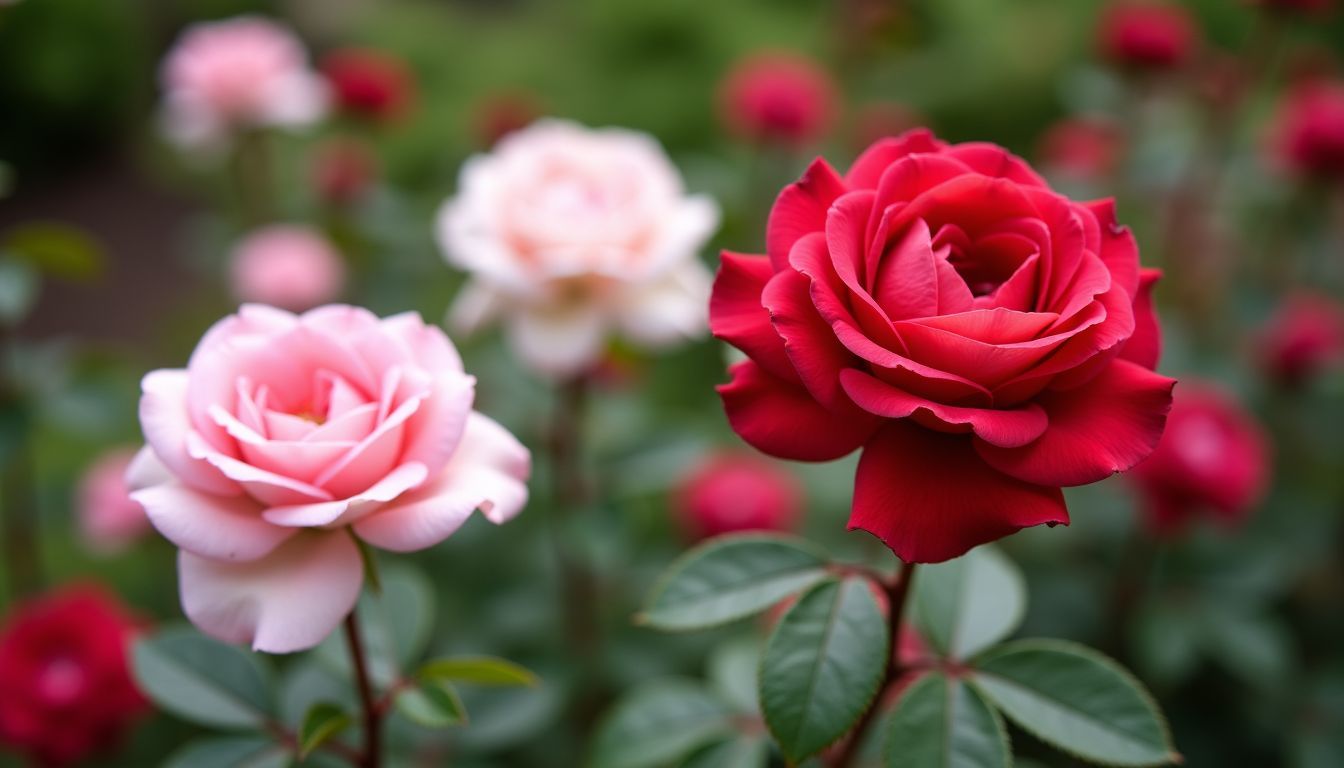
People love Floribundas because they look great in a rose garden. These garden roses are perfect for borders or as decorative focal points. They also have good resistance to diseases compared to Hybrid Teas.
So, if you want colorful and hardy roses, give Floribundas a try!

Climbers and ramblers are types of roses that grow long canes in a rose garden. Climbers can reach over 15 feet tall, making them ideal for covering walls, fences, and trellises. Their flowers bloom repeatedly in the season.
Ramblers also grow long but tend to be more flexible than climbers. They often produce a massive display of blooms once a year. Both types add vertical interest to gardens—great for arbors and lattice work.
Next up is shrub and landscape roses…
Shrub and landscape roses are great for busy gardeners in a rose garden. These roses need little care and still look good. Options like Knock Out Roses, Drift Roses, Easy Elegance Roses, David Austin Roses, and Oso Easy Roses thrive with minimal work.
In a rose garden these types of roses are hardy and resilient. They can handle different weather conditions well. “You can’t go wrong with Knock Out or Oso Easy,” says a garden expert. They offer stunning blooms all season long!

Roses can brighten your garden with their beauty and scent… Explore how they also boost well-being!
Beautiful roses make any garden, not only a rose garden, look impressive. With their wide variety of colors and forms, they stand out with elegance. Red roses symbolize love. Yellow ones bring cheerfulness.
White roses add purity and peace.
Their blooms are a feast for the eyes. Delicate petals unfold in stunning patterns. Roses can be single, double, or clustered into rich bunches—creating different looks across your garden space.
These flowers turn gardens into visual masterpieces brimming with romantic beauty and botanical charm.
Many roses in a rose garden are known for their pleasant fragrance. This can enhance the garden atmosphere, making it a lovely place to relax.
Growing fragrant roses also improves the aroma of the surrounding area. A garden filled with fragrant blooms can uplift your mood and create a welcoming space for guests.
Roses are more than just pretty flowers. They have good health benefits, too. Rose petals and rosehips contain antioxidants that can help fight diseases. These antioxidants protect your cells from damage.
Drinking rose tea or using rose extracts may aid digestion and reduce inflammation. The natural oils in roses can also improve skin health, helping to soothe irritation and redness.
Use rose-based products for a simple way to enjoy these benefits every day!
Rose gardening can be challenging. in A rose garden, Roses need a lot of care and attention.
A Rose garden need regular care. They require watering, fertilization, and pruning to thrive. Pay attention to detail in rose care.
Water your roses deeply every week. Use a soaker hose for best results. Apply fertilizer in spring and mid-summer. Choose a balanced formula for healthy growth.

Prune roses each year to remove dead wood and shape the plants. Early spring is the best time for this task. Discard any diseased stems quickly to prevent spread.
These gardening tasks may seem demanding but they keep your garden beautiful and blooming!
A rose garden often face pests and diseases. Common rose pests include aphids, beetles, and spider mites. They can cause damage by sucking sap or chewing on leaves.
Diseases like powdery mildew and black spot are also frequent problems. Powdery mildew shows up as white patches on leaves, while black spot creates dark spots with yellow edges. Use neem oil or insecticidal soap to manage these issues.
Regular monitoring helps catch problems early before they spread widely in your rose garden.
A Rose Garden is prone to a small set of very common fungal diseases (like black spot and powdery mildew), several serious viral and bacterial diseases, plus a predictable roster of sap‑sucking and chewing insects. Managing them usually means combining good hygiene, resistant varieties, and targeted treatments rather than relying on a single spray.
Black spot: Circular black spots with fringed edges on leaves, usually with yellow halos; foliage often yellows and drops prematurely, weakening the plant. It thrives in warm, wet weather and is controlled with good air circulation, careful watering, removal of infected leaves, and protective fungicides where needed.
Powdery mildew: White, talc-like coating on young leaves, buds, and stems that can cause distortion and reduced vigour. It tends to be worst in warm days and cool nights and is reduced by pruning for airflow, avoiding overhead watering, and, if needed, using sulphur or other suitable fungicides preventively.
Rust and downy mildew: Rust shows as orange pustules on leaf undersides; downy mildew as purple-red leaf blotches with greyish growth under the leaf in cool, damp weather. Removing affected leaves, improving drainage and spacing, and, in severe climates, applying appropriate fungicides are standard management options.
Canker and dieback: Dark, sunken, or discoloured lesions on canes that can girdle stems and cause sudden dieback, often entering through pruning wounds or winter damage. Control centers on pruning back into healthy wood, disinfecting tools, avoiding stress, and removing badly affected canes or plants.
Crown gall: Rough, tumour-like galls at or just above soil level caused by a soil-borne bacterium; affected plants often show poor growth and may decline. There is no cure on the plant, so gardeners typically remove and destroy infected specimens and avoid replanting roses in the exact spot for several years.
Rose mosaic and rose rosette: Viral diseases causing yellow mottling or rings (mosaic) or witches’ brooms, excessive thorniness, and distorted red shoots (rosette). Both are essentially incurable in the garden; the usual recommendation is to remove infected plants and use only certified, virus‑indexed stock
Aphids: Small green, black, or pink sap‑suckers clustering on tender shoots and buds, causing distortion and sticky honeydew. Strong water jets, encouraging predators (ladybirds, hoverflies), or using insecticidal soap or oils can keep populations in check.
Spider mites and thrips: Mites cause fine stippling, bronzing, and webbing on leaves, especially in hot, dry weather; thrips scar petals and discolour buds. Management relies on regular monitoring, washing foliage, raising humidity, and using targeted miticides or insecticides only when necessary to protect beneficial insects.
Rose sawfly (rose slug) and beetles: Sawfly larvae skeletonise leaves, leaving a window‑pane effect, while beetles chew holes or petals. Handpicking, removing affected foliage, and (if required) using appropriate contact insecticides or biological controls help limit damage.
Choose disease‑resistant varieties suited to your climate and avoid overcrowding plantings.
Water at the base in the morning, keep foliage as dry as possible, and clear fallen leaves and petals to reduce fungal inoculum.
Prune correctly to open the center of the bush and remove weak or crossing wood, and disinfect tools between plants when dealing with canker or virus‑suspect material.
If you tell the climate you garden in and whether your roses are in beds or pots, a more tailored short list of the most likely pests and diseases (and specific organic vs conventional controls) can be outlined.

Choose roses suited to your local climate. Prepare the soil well and ensure good drainage… proper care starts from the ground up!
Selecting the right varieties for your climate is key to growing healthy roses. Roses thrive in USDA Hardiness Zones 3-11, so check what zone you live in. Different zones have different best-suited varieties.
For instance, if you live in a cooler area (Zone 3), pick hardy varieties that can stand cold winters.
Also, look for disease-resistant types, as they often fare better and require less care. This will save time and keep your garden looking great. Some good choices include Knock Out roses or Drift roses which are known for their hardiness across many climates.
Choosing roses suited to your climate is key. Warm areas favor Hybrid Teas, while cool regions might do better with Floribundas.
First, pick a sunny spot—roses need at least six hours of sunlight each day. Dig a hole 18-30 inches wide and deep for bare-root roses. This will give roots space to grow. Mix compost into the soil before planting; this enriches it and helps with drainage.
Ideal times to plant are in spring after the last frost or fall, allowing six weeks before the first frost. Water well after planting to settle the soil around the roots.
Keep the soil evenly moist. Roses need about 1 inch of rainfall each week. You may use a rain gauge to track this. Water them deeply once or twice a week if it doesn’t rain. Avoid getting water on the leaves to prevent diseases.
Use slow-release fertilizers like Jobe’s Organic Fertilizer Spikes. Apply them in early spring when new growth starts and again after the first bloom cycle. Too much fertilizer can harm roses, so follow package instructions carefully for best results.
Prune roses early in spring. Use bypass pruners and rose pruning gloves to protect your hands. Cut back dead or damaged canes first. Trim healthy canes by one-third to promote growth.
Check for diseased canes often; remove them promptly. Regular trimming keeps shrubs tidy and enhances blooms. Follow these simple steps for a beautiful garden all year long!
Roses need one main structural prune in late winter plus lighter pruning and deadheading in spring and summer, with only minimal cutting in autumn and early winter. Exact dates shift with climate, but most schedules key off last frost and flowering times.
Prune most bush and shrub roses in late winter when growth just starts to resume, often February–March in temperate climates, or when forsythia blooms locally.
Aim to prune before vigorous new growth is well under way, but after the worst hard frosts have passed.
Remove all dead, diseased, crossing, and weak stems, then shorten remaining canes according to rose type (for example, hybrid teas and floribundas down to 20–30 cm with 3–5 strong shoots, shrub roses reduced by about one‑third).
Shape plants to an open “vase” with outward‑facing buds, making cuts 0.5–1 cm above a bud at a slight angle, then clear debris and mulch/feed.
Through spring (roughly March–May), continue light pruning as buds break and damage from winter becomes visible.
Cut out any additional winter‑killed tips back to healthy white pith, shorten uneven or overly long shoots slightly, and remove suckers from below the graft union.
For once‑flowering old roses and ramblers, delay main pruning until just after they bloom later in the season, as pruning them now would remove flower buds.
In summer (June–August), avoid heavy pruning but deadhead regularly and do light shaping to keep repeat‑flowering roses productive.
Snip off spent blooms down to the first strong outward‑facing leaf with 5 leaflets, which encourages more flowers and a neater plant.
After flowering, prune rambling roses in late summer by removing one or two of the oldest stems at the base and tying in new shoots, and lightly shortening side shoots on climbers as needed.
From early autumn through early winter (roughly September–December), keep pruning light so you do not stimulate soft new growth before dormancy.
Remove only dead, diseased, or badly damaged wood, and, in very windy sites, lightly shorten tall stems to reduce wind‑rock without doing a full structural prune.
Reserve major reshaping and renovation for the dormant‑season pruning window (late autumn to late winter, depending on type and climate).
Main prune in late winter; deadhead and lightly tidy through summer; minimal cuts in autumn.
Prune right after flowering in early or late summer to avoid removing next year’s flower wood; carry out heavier renovation between late autumn and late winter.
In mild climates, prune slightly earlier; in cold regions, delay until closer to the last frost and bud swell.
If you say which hardiness zone or country you garden in and what types of roses you grow (hybrid tea, shrub, climber, rambler), this schedule can be turned into a zone‑specific month‑by‑month checklist.

Managing Pests and Diseases in Rose Gardens: Learn how to protect your roses from common threats and keep them healthy….
Aphids, spider mites, and Japanese beetles are common rose pests. Aphids suck the sap from new shoots. They leave behind a sticky residue called honeydew. Spider mites create tiny webs on roses and can cause leaves to turn yellow.
Japanese beetles chew on rose petals and leaves.
Neem oil, insecticidal soap, or a strong water spray can control these pests. Natural methods also help. Planting alliums like garlic or onions near your roses repels some insects.
Regular checking and quick action keep your roses healthy!
Pests can weaken roses, but diseases pose an even bigger threat. Two common problems are powdery mildew and black spot. Powdery mildew looks like white dust on leaves and stems. Black spot shows as black spots with yellow halos on leaves.
To control these diseases, maintain good air circulation around plants. This reduces moisture which helps prevent fungal infections. Choose disease-resistant varieties of roses when planting your garden.
Use fungicides if infections occur—this can stop the spread of mildew or black spot quickly.

Growing roses can be rewarding and beautiful. Make sure to choose the right types for your garden. Care for them with proper watering, feeding, and pruning. Don’t let pests or diseases stop you; there are simple solutions! Start small—pick easy varieties like Knock Out Roses—and enjoy the journey of rose gardening.
Ready to plant some roses? Get out there and create a stunning rose garden today!
A Rose garden can be formal or informal. Formal rose gardens often have symmetrical designs and structured layouts, while informal ones feature a more natural arrangement. Both types offer unique beauty.
Rose gardens bring aesthetic pleasure with their vibrant colors and fragrances. They also attract pollinators like bees and butterflies, enhancing local ecosystems.
Yes, rose gardens require regular care—like pruning, watering, and pest control—which can be time-consuming. Additionally, some roses are susceptible to diseases that need attention.
Choose the right location with plenty of sunlight and good soil drainage. Select disease-resistant varieties if you’re new to gardening… And don’t forget to mulch! It helps retain moisture and suppress weeds.