Cart is empty





TAKE THE QUIZ

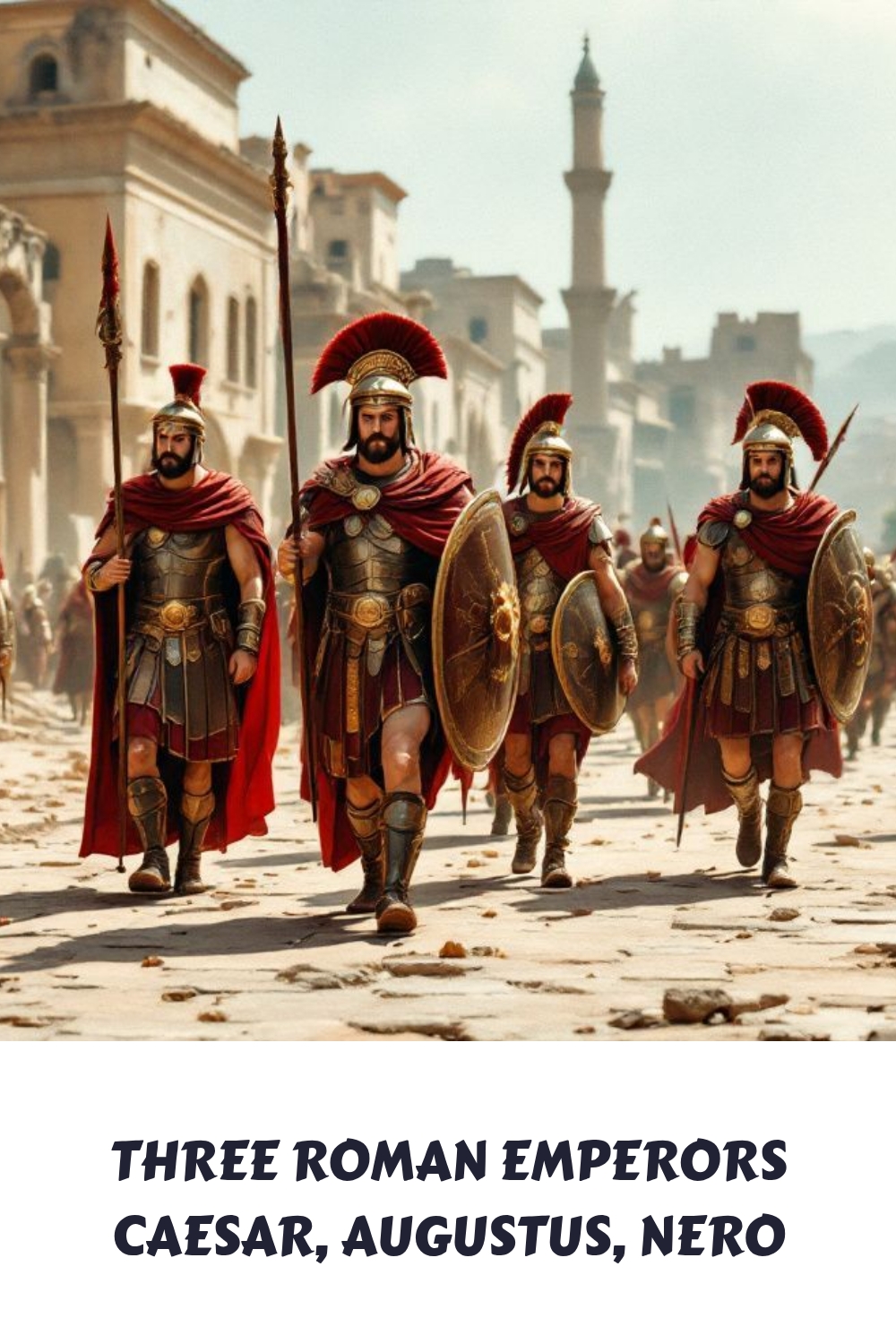
Three Roman Emperors
This Podcast provides an overview of three prominent Roman emperors: Julius Caesar, Augustus, and Nero. It explores their rise to power, their distinct leadership styles, and their significant impacts on the Roman Empire. The information details Caesar’s role in the Republic’s transition, Augustus’s establishment of the Principate and the Pax Romana, and Nero’s controversial reign marked by the Great Fire of Rome. The sources compare their legacies and contributions, highlighting how each figure uniquely shaped Roman history and perceptions.
Three Roman Emperors: A Briefing on Power, Legacy, and Transformation
This podcast examines the lives and legacies of three Roman figures: Julius Caesar, Augustus (Octavian), and Nero. These individuals, each with distinct leadership styles and impacts, fundamentally shaped the Roman world, transitioning it from a Republic to an Empire and illustrating the complexities of power, ambition, and governance.
Julius Caesar: The Architect of Transition
Julius Caesar (100–44 BC) was a charismatic general and statesman of the three Roman Emperors whose actions irrevocably altered the course of Roman history, paving the way for the Empire.
Rise to Power
- Early Life and Political Beginnings: Born into the Patrician Julian family, Caesar’s early life was marked by the “political turbulence of the Roman Republic.” His uncle by marriage, Gaius Marius, a renowned general, influenced his ambitions. Caesar began his ascent through successful military campaigns in Asia and as a prosecutor of corruption in the Roman Senate.
- First Triumvirate: In 60 BC, Caesar formed the First Triumvirate with Pompey the Great and Marcus Licinius Crassus, dominating Roman politics through this alliance.
- Gallic Wars and Military Genius: As governor of Gaul (58-50 BC), Caesar’s “decade long campaign… expanded Rome’s territories to the Atlantic Ocean and brought immense wealth to Rome.” His “detailed accounts of the Gallic Wars known as commentary I deell galico offer a glimpse into his strategic prow and ability to sway public opinion through propaganda.” His victory at the Battle of Alesia (52 BC) cemented his reputation and provided him with “resources and Veteran Legions necessary for his next Bowl move seizing power in Rome.”
- Crossing the Rubicon and Civil War: Tensions with Pompey and the Senate escalated after Crassus’s death. When ordered to disband his army, Caesar defiantly “crossed the Rubicon River with his Legion” in 49 BC, initiating a civil war. This act became “synonymous with passing the point of no return.” After defeating Pompey at the Battle of Pharsalus (48 BC), Caesar became the “unrivaled leader of Rome.”
- Dictator for Life: In 44 BC, Caesar was appointed “dictator Perpetual – dictator for life.”
Reforms and Centralization of Authority
- Caesar initiated reforms aimed at stabilizing Rome, most notably the Julian calendar, a precursor to the modern Gregorian calendar.
- His “centralization of power however alarmed many senators who feared the end of the Republic and the rise of monarchy.”
- He “reworked the government, and made Rome stronger at its core,” setting a precedent for future emperors.
- Tactics for Expansion: Caesar employed a range of strategies, including:
- “Pretext for Invasion” to justify military actions.
- “Divide and Conquer” by exploiting divisions among tribes.
- “Resource Denial and Siege Warfare” to force surrender.
- “Rapid Mobilization and Engineering” for swift advances and infrastructure building (e.g., bridges across the Rhine).
- “Psychological Warfare” through brutal examples (e.g., mass slaughter of Usipetes and Tencteri).
- “Winter Campaigns and Permanent Presence” to solidify control.
- “Naval Innovation” as seen against the Veneti.
- “Publicity and Political Manipulation” through his writings.
- “Cross-Border Demonstrations” to intimidate.
Assassination and Legacy
- Ides of March: On March 15, 44 BC, Caesar was “assassinated by a group of senators, including his friend Brutus and other prominent figures like Cassius and Casca.” They believed this would “restore the Republic.”
- Consequences: His death “instead it led to another series of civil wars that ultimately ended with the rise of Caesar’s adopted Heir Octavian later Augustus and the establishment of the Roman Empire.”
- Enduring Impact: Caesar’s legacy is “profound.” He “not only expanded Rome’s territory significantly but also laid the groundwork for the transition from Republic to Empire.” His name became “synonymous with imperial rule, influencing titles like ‘Kaiser’ and ‘Tsar’.”
Augustus: The Founder of the Roman Empire and Pax Romana
Augustus (63 BC–AD 14), born Gaius Octavius, was Julius Caesar’s adopted son and heir. He is credited with bringing about the downfall of the Roman Republic and the rise of the Roman Empire. Initiating a period of unprecedented peace and prosperity under these three Roman Emperors.
Early Life and Ascension to Power
- Birth and Family: Born on the Palatine Hill in Rome on September 23, 63 BC, to a “respected plebeian family” that became “patrician thanks to their connections with Julius Caesar.” His mother, Atia, was Caesar’s niece, making Caesar his great-uncle.
- Caesar’s Heir: After Caesar’s assassination in 44 BC, Caesar’s will “dictated that he will adopt Octavian as his son and Heir.” Despite advice to hide, Octavian (then 19) “immediately sailed for Rome” and decided to “carry on Caesar’s name in political Legacy.” He changed his name to Gaius Julius Caesar.
- Formation of the Second Triumvirate: Octavian demonstrated “strong leadership skills” by raising a private army, winning over Mark Antony’s legions. After initial conflicts with Antony and the Senate, Octavian joined forces with Antony and Marcus Aemilius Lepidus, forming the Second Triumvirate in 43 BC.
- Proscriptions: The Triumvirate set in motion “a series of proscriptions where 300 Senators and 2,000 equites were labeled as Outlaws and all of their possessions confiscated… to make some quick cash for their upcoming war with Brutus and Longinus.”
- Defeat of the Assassins: Octavian and Antony defeated Brutus and Longinus at the Battle of Philippi in 42 BC.
- Consolidation of Power: The triumvirate divided Roman provinces, with Octavian receiving the Western provinces. Lepidus was later expelled (36 BC). Antony’s alliance with Cleopatra, his divorce from Octavian’s sister Octavia, and propaganda campaigns by Octavian led to the decisive Battle of Actium (31 BC), where Octavian’s forces defeated Antony and Cleopatra. Both committed suicide, leaving “Octavian as the most powerful man in the Republic.”
The Principate and Golden Age
- Principate and Titles: Octavian did not immediately become dictator. Through “political maneuvers known as the first and second settlements,” he consolidated power under the “principate,” a “dictatorship that preserves some illusions of a republic.” He stylized himself as “princeps civitatis” (first citizen). In 27 BC, the Senate awarded him the titles “Augustus” and “princeps.” In 19 BC, he officially received “Imperium Maius” (supreme power). He became “Imperator Caesar Divi Filius Augustus” (“the Son of God”).
- Pax Romana: Augustus “ushered in a golden age for the Roman civilization.” His reign initiated the “Pax Romana,” a “200-year period of relative peace and prosperity.” He “transformed Rome into a stable, peaceful, and prosperous Empire.”
- Key Contributions and Reforms:
- Territorial Expansion: Expanded the Empire from modern-day Portugal to Syria, conquering territories in Spain, Switzerland, Germany, Austria, Slovenia, Albania, Croatia, and Hungary.
- Diplomacy: Negotiated a “temporary peace with the Parthians.”
- Public Services: Created an “institutionalized police and firefighting force” and established the Praetorian Guard.
- Economic Reforms: Implemented “tax reforms which stabilized tax rates and greatly increased Rome’s treasury.”
- Social Reforms: Passed laws to “raise birth rates,” making “adultery illegal, offering tax incentives for families with three or more children, and penalties for childless marriages.” He even exiled his own daughter for adultery.
- Infrastructure and Arts: Initiated “many major construction projects,” including the Temple of Caesar, Baths of Agrippa, and Forum of Augustus. He “built or restored 82 temples in a single year.” He also supported the construction of the Pantheon.
- Cultural Impact: Renamed the eighth month of the year to “August” in his honor.
- Character and Leadership: Described as “ambitious, intelligent, a man who can be cruel but also wise and fair.” His cruelty was mostly during his ascension. After consolidating power, he became a “fair and moderate ruler.” He “killed only for political reasons,” not for amusement. He was “extraordinarily wealthy but cared little for luxuries,” donating large sums to the Roman treasury. He kept an “open mind to Art and philosophy and allowed some free speech.”
Death and Lasting Legacy
- Augustus died in 14 AD at age 75. His public last words were, “I found Rome a city of bricks and left it a city of marble.”
- His death was “seen as the loss of a great ruler brimming with talent and vision.” He was “proclaimed a god among the host of the Roman pantheon.”
- His reign set the “foundations for civilization which would be more or less peaceful for more than 200 years.” He is considered a “natural top choice” for lists of greatest Roman emperors, praised for his “administrative and military reforms” and for being “a model for later emperors.”
Nero: The Controversial and Infamous Emperor
Nero (AD 37–68) is widely regarded as one of Rome’s most controversial and cruel emperors, though historical bias in sources is acknowledged. His reign saw initial promise devolve into tyranny, ultimately leading to his downfall.
Early Life and Accession
- Birth and Family: Born Lucius Domitius Ahenobarbus in 37 AD, he was later renamed Nero Claudius Caesar Drusus Germanicus upon adoption. His mother was Agrippina the Younger, and his father was Gnaeus Domitius Ahenobarbus, described as “loathsome in every respect.”
- Exile and Return: Exiled with his family by Caligula, they returned to Rome after Caligula’s assassination.
- Adoption by Claudius: In 49 AD, Agrippina married her uncle, Emperor Claudius, and persuaded him to adopt Nero as his son and heir in 50 AD.
- Accession: Claudius died in 54 AD, possibly poisoned by Agrippina, allowing Nero to ascend to the throne at 16, unopposed.
Early Reign and Popular Measures
- Golden Age: “Nero’s early years as Emperor were generally considered to be a golden age.” The arts flourished, and Rome experienced “peace and prosperity.”
- Advisors: His tutor and advisor, the Stoic philosopher Seneca, is credited with guiding the young emperor, along with Burrus, head of the Praetorian Guard.
- Public Favor: He was considered “kind and approachable,” encouraging adulation from commoners. He “lowered taxes and gave slaves better protection.”
- Public Works and Entertainment: He paid for “extravagantly lavish games, plays, concerts, chariot races and gladiatorial fights.” He initiated “high-profile infrastructure projects constructing New Roads, Bridges, and aqueducts.” He rebuilt parts of Rome to be “more splendid than before.”
Decline and Notorious Actions
- Toxic Relationship with Agrippina: Nero’s relationship with his mother became “quite toxic.” She tried to “manipulate him to some onlookers it appeared that she wanted to rule the Empire by using her son as her political puppet.” Nero began to distance himself, eventually ordering her removal from the palace (55 AD) and her murder (59 AD). Accounts describe failed attempts involving a collapsing boat and ceiling, before finally being killed by Anicetus, commander of Nero’s fleet.
- Murder of Britannicus: Nero poisoned his stepbrother Britannicus at a dinner party (55 AD), likely to remove a rival and warn his mother.
- Marital Troubles and Murders:
- Octavia: Nero disliked his first wife, Claudia Octavia (Claudius’s daughter), who was popular. He accused her of unfaithfulness, divorced her, exiled her, and later had her murdered in 62 AD.
- Poppaea Sabina: He married Poppaea Sabina, who was already married to his friend Otho (whom he sent away). While Poppaea was pregnant with their second child, Nero “kicked her to death” in a “casual outburst of rage” in 65 AD.
- Antonia and Statilia Messalina: He tried to marry Antonia, Claudius’s other daughter, but had her executed when she refused. He then married Statilia Messalina after disposing of her husband.
- The Great Fire of Rome (64 AD): A “massive fire broke out in the suburbs of Rome and quickly burnt out of control,” destroying much of the city. Rumors spread that “Nero played music while the city burned,” hurting his image. Some sources claim he started it to clear space for his planned Domus Aurea.
- Persecution of Christians: To deflect blame for the fire, “Nero used the Christian religion as a scapegoat.” Thousands were “arrested, tortured and killed in public spectacles,” often thrown to beasts, crucified, or “burnt alive as human torches.” Apostles Peter and Paul are believed to have been martyred during his reign.
- Extravagant Projects and Taxes: After the fire, Nero began rebuilding, including his “lavish new project,” the Domus Aurea (Golden House), a “sprawling palace complex” with innovative engineering, an artificial lake, and a 100ft bronze statue of himself. To fund this, he “raised taxes which was very unpopular,” and emptied imperial treasuries.
- Love for Greek Culture and Olympic Games: Nero toured Greece (66-67 AD), unusually for a reigning emperor, to immerse himself in Greek culture. He participated in the Olympic Games, including chariot races, and “still made sure that he was declared the winner of every event he participated in.”
- Conspiracies and Downfall: His extravagance and tyranny led to conspiracies, notably the Pisonian conspiracy (65 AD), which he brutally suppressed, forcing his former advisor Seneca to commit suicide. In 68 AD, governors Vindex in Gaul and Galba in Spain rebelled. The Senate declared Nero a “public enemy,” and the Praetorian Guard abandoned him. With no one left to carry out his plans, Nero fled Rome and committed suicide with the help of a servant, uttering, “What an artist the world is losing.” He died at 30, the last of the Julio-Claudian dynasty.
Legacy and Historical Perception
- Nero is “remembered as one of the cruellest and most depraved” Roman emperors, associated with “oppression and disregard during emergencies.”
- However, historical sources are often biased, written by those seeking to vilify the previous dynasty. Thus, whether he “played a fiddle” as Rome burned or heroically “assisted with the relief effort” is debated.
- Despite his notorious reputation, he made significant architectural contributions, especially in urban planning and fire safety after the Great Fire, though his Domus Aurea was later dismantled.
- His death led to the “chaos and Civil Wars of the year of the four emperors.”
Comparative Analysis and Key Takeaways
The reigns of Julius Caesar, Augustus, and Nero represent distinct phases in Roman history, illustrating varied leadership styles and their profound impacts.
Leadership Styles and Impacts of the three Roman Emperors
- Julius Caesar: Charismatic, autocratic, and popular with his army, he “brought Rome under tight control” and initiated the transition from Republic to Empire. His reforms centralized power, but his ambition led to civil war and assassination.
- Augustus: Cautious, politically astute, and a master of subtly centralizing power while maintaining the “facade of republican governance.” He initiated a long period of peace and stability, laying the “sturdy base for the Roman Empire.” He blended tradition with unbridled power.
- Nero: Initially moderate and popular, his rule later became erratic and autocratic, marked by cruelty, extravagance, and persecution. His “personal missteps could result in catastrophe.”
Legacies and Historical Perceptions
- Julius Caesar: The “catalyst for end of Republic,” his name became an imperial title. He is seen as the “architect of Rome’s transition.”
- Augustus: “Founder of the Roman Empire,” model for later emperors, and revered for establishing the “Pax Romana.” He is largely considered a hero who “fortified and stabilized the empire.”
- Nero: Notorious for “excess and persecution,” he is the “last of Julio-Claudian line.” While criticized for tyranny and disregard, some acknowledge his post-fire reconstruction efforts. His legacy is “frequently recalled for negative aspects.”