
 Cart is empty





TAKE THE QUIZ
Italian Renaissance Art
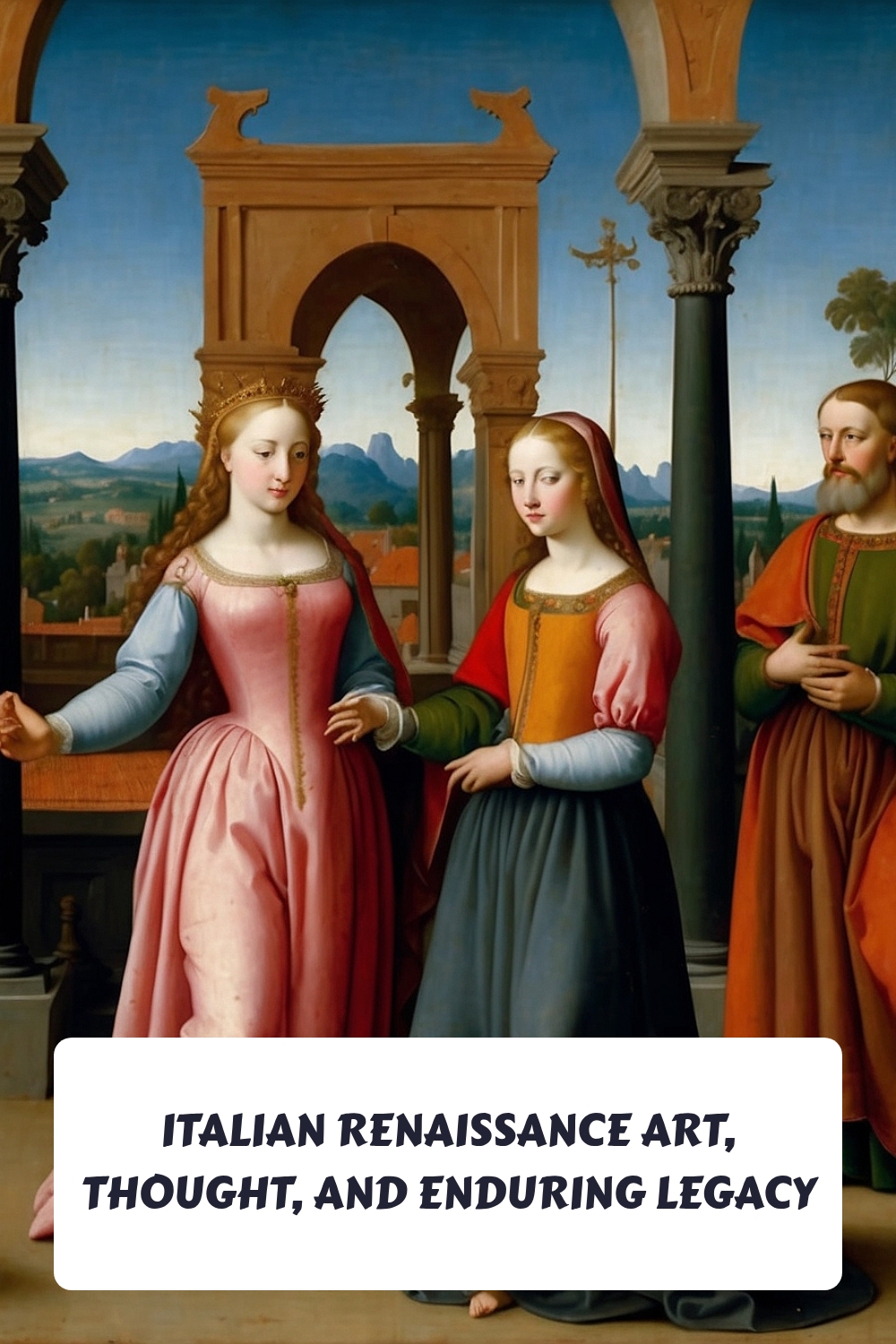
The Podcast offers an in-depth exploration of the Italian Renaissance Art during this Period. Detailing its historical span, key features, and enduring legacy. They highlight the artistic and cultural innovations that emerged between approximately 1340 and 1600, emphasizing the contributions of influential figures such as Leonardo da Vinci, Michelangelo, and Raphael, as well as the significant patronage of the Medici family.
The Podcast thoroughly describe pivotal cities like Florence, Rome, Venice, and Milan, showcasing their iconic architectural achievements and masterpieces such as the Sistine Chapel and the Florence Cathedral. Additionally, they discuss the rise of humanism, its impact on modern science and culture, and the vital preservation efforts undertaken by museums and restoration projects to safeguard this rich heritage.
What was the Renaissance and when did it occur?
The Renaissance was a significant period in European history, primarily centered in Italy, spanning from the 14th to the 16th century. The word “Renaissance” literally means “rebirth,” and it signifies a rebirth of classical Greek and Roman arts and philosophy. This era bridged the gap between the Middle Ages, often characterized by conflict, cultural decline, and pandemics like the Black Death, and the dawn of modern civilization.
While there’s no single, universally agreed-upon starting point, and some historians view it more as an evolution than a distinct break from the Middle Ages, it generally saw a renewed interest in classical knowledge, a shift towards human-centered thought and the birth of Italian Renaissance Art.
Where did the Renaissance begin and why?
The Renaissance primarily began in Florence, Italy, a city that amassed significant wealth through extensive trade with the Ottoman Empire and other regions. This economic prosperity created a wealthy merchant class, most notably the powerful Medici family, who became crucial patrons of the arts and intellectual pursuits.
Other contributing factors to Italy being the “cradle of the Renaissance” include its direct access to Roman ruins and artifacts, which provided tangible examples of classical ideals, and the influx of Greek scholars and classical texts following the fall of Constantinople in 1453. Italy’s independent city-states, like Florence, Venice, Rome, and Milan. Also fostered an environment where Italian Renaissance Art and other cultural interests could flourish without external interference.
What was “humanism” and how did it influence the Renaissance?
Humanism was a central philosophy of the Renaissance, inspired by classical Greek and Roman texts. It celebrated human creativity, individual achievement across various fields, and promoted the idea that “man was the center of his own universe, not god.” This new mindset contrasted sharply with medieval philosophy, which largely focused on the divine and adhering to the rules set by the Catholic Church.
Humanism emphasized the study of ancient texts, human potential, and reason. This led to a new discipline called philology, the study of language history, and influenced education by promoting “liberal studies” like rhetoric, grammar, logic, and history. The shift towards human observation and reason also significantly contributed to the rise of naturalism in art and advancements in science.
How did art and architecture change during the Renaissance?
Italian Renaissance art and architecture underwent significant transformations, marking a departure from earlier medieval styles. A prominent feature was the furthering of the arts, reaching its apex during the High Renaissance with masters like Leonardo da Vinci, Raphael, and Michelangelo. Key changes included:
Naturalism and Realism
Artists aimed to portray the world as it was, with anatomically accurate human bodies in complex poses, dramatic and emotional compositions, and naturalistic depictions of space.
Geometric Perspective
A new technique, like linear perspective, was employed to create the illusion of realistic depth in scenes, as seen in Leonardo da Vinci’s “The Last Supper.”
Classical Revival
There was a deliberate effort to revitalize the visual cultures of Greece and Rome, incorporating classical orders (Doric, Ionic, Corinthian columns), monumental sculptures, and idealized figures.
Shift in Subject Matter
While religious themes remained prevalent, Renaissance artists also branched out into personal, political, and classical themes, reflecting the humanist emphasis on human experience.
Architectural Innovation
Filippo Brunelleschi’s dome of the Florence Cathedral is a prime example of Renaissance architectural style, showcasing mastery of engineering and classical elements.
Who were some of the most influential figures of the Italian Renaissance Art world?
The Italian Renaissance was shaped by a constellation of brilliant minds across various disciplines:
Francesco Petrarch
Often called the “Father of Humanism,” he laid the intellectual framework for the movement through his emphasis on classical texts and human potential.
Leonardo da Vinci
A true “polymath,” he excelled as an artist (e.g., Mona Lisa, The Last Supper), scientist, and inventor, blending artistry with scientific inquiry.
Michelangelo
A masterful sculptor, painter, and architect, known for works like the Statue of David, the Sistine Chapel ceiling, and his contributions to St. Peter’s Basilica.
Raphael
Renowned for his harmonious and graceful paintings, including the School of Athens and frescoes in the Vatican Museums, he masterfully captured human emotion and perspective. He was a key figure in Italian Renaissance Art.
Medici Family
Though not artists themselves, this powerful Florentine banking family, particularly Lorenzo de’ Medici (“the Magnificent”), were crucial patrons, funding countless artists, architects, and thinkers and making Florence a hub of creativity in Italian Renaissance Art.
Niccolò Machiavelli
Author of “The Prince,” his work explored the practicalities of wielding political power, advocating for a ruler’s main goal to be the preservation of power at all costs, a significant departure from previous ethical guidelines for rulers.
Giotto di Bondone
Often considered a “proto-Renaissance” artist, his innovations in depicting three-dimensional figures, space, and emotion in the early 14th century paved the way for later Renaissance masters in the Italian Renaissance Art world.
How did the Renaissance challenge the authority of the Catholic Church?
The Renaissance fostered a climate of intellectual inquiry and individualism that gradually led to a questioning of the Catholic Church’s authority. The rise of humanism shifted focus from solely divine matters to human potential and reasoning. Increased trade and a labor shortage due to the Black Death gave rise to a middle class, who began demanding wages and better living conditions, further challenging the feudal system and the Church’s entrenched power structure.
This context, coupled with growing dissatisfaction with practices like nepotism and the selling of indulgences, led to the Protestant Reformation, spearheaded by Martin Luther. This revolutionary movement caused a significant split within the Catholic Church, reducing its widespread influence and leading to a period of censorship and the establishment of the Inquisition as the Church sought to reassert its control.
What were some of the broader societal and intellectual changes during the Renaissance?
Beyond art and philosophy, the Renaissance brought about significant societal and intellectual shifts:
Decline of Feudalism and Rise of Capitalism
Increased trade and the labor shortage caused by the Black Death contributed to the fall of feudalism and the emergence of a capitalist market economy, fostering a new middle class.
Spread of Ideas through Printing
Johannes Gutenberg’s development of the printing press in Europe revolutionized the distribution of knowledge, allowing early humanist authors’ texts and other literature to reach a wider audience.
Age of Exploration
Driven by a desire to break Ottoman dominance over trade routes to India and the Far East, European explorers like Christopher Columbus and Ferdinand Magellan embarked on voyages that expanded global understanding and connections.
Scientific Breakthroughs
Astronomers like Nicolaus Copernicus challenged the geocentric model by proposing a heliocentric solar system, and Galileo Galilei later provided evidence for this, improved the telescope, and conducted experiments that laid the groundwork for future scientific discoveries.
Civic Humanism
The application of humanist principles to the public sphere led to “civic humanism,” where educated individuals were encouraged to deploy their knowledge in service of the state, as seen in the writings of figures like Baldassare Castiglione and Leonardo Bruni.
Why is the Renaissance still studied today, despite debates about its historical categorization?
The Renaissance is extensively studied today not just for its historical context in the 15th century, but primarily for its lasting legacy and influence on the Euro-American world. The core ideas of humanism and individualism that emerged during this period profoundly shaped Western culture, influencing art, science, philosophy, and political thought for centuries.
While historians debate whether it was a clear-cut historical period or more of a gradual cultural movement, and acknowledge that its impact was largely confined to the elite, its artistic masterpieces, intellectual breakthroughs, and emphasis on human potential continue to resonate and inspire. The Renaissance laid essential groundwork for later periods like the Scientific Revolution and the Enlightenment, making its study crucial for understanding the trajectory of modern civilization.