Core Mechanics of Roman Numerals
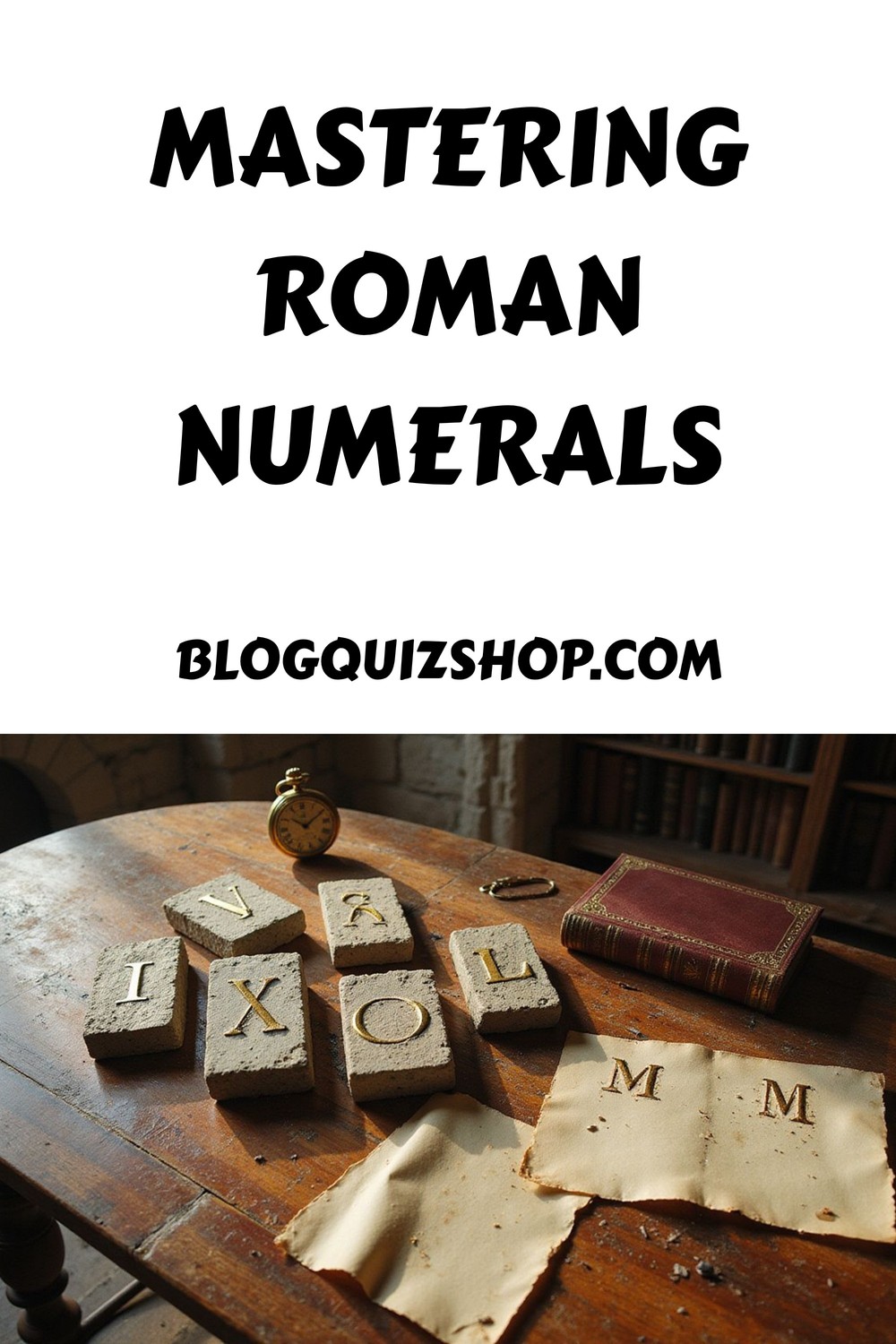
What steps can lead you to the Mastering Roman Numerals? The Roman numeral system relies on seven basic letters as building blocks: I (1), V (5), X (10), L (50), C (100), D (500), and M (1000). Every number recorded throughout the empire was a specific combination of these symbols, functioning like packing a suitcase with the least amount of space possible.
The Rule of Placement
In the Mastering Roman Numerals, the system utilizes placement to dictate addition and subtraction patterns. A smaller numeral placed after a larger one creates an additive effect, such as VI (5 + 1 = 6). Conversely, placing a smaller numeral before a larger one dictates subtraction, representing one less than the larger value, such as IV (1 less than 5 = 4). This process is key to the Mastering Roman Numerals.
Calculation and Efficiency
The Roman system was not designed for complex manual arithmetic. Rather, it functioned as the final tally. Romans performed actual math using physical tools like counting boards (abacuses) or lines in the sand with pebbles. The numerals were simply the receipt, used to record the final total of operations performed physically.
The Evolution and Modern Use of Numerals
Cultural Myths vs. Practical Origins
- The popular ‘hand theory’—suggesting symbols like V and X evolved from visual representations of hand gestures—is an academic myth.
- Symbols actually derive from ancient Etruscan tally marks used by shepherds to count livestock.
- These marks were initially vertical lines that evolved into V, X, and other forms as visual milestones to simplify counting.
- in the Mastering Roman Numerals, the system transitioned from a functional tool to aesthetic markers in the Renaissance and beyond as Hindu-Arabic numerals became the standard for mathematical precision.
- Hindu-Arabic numerals were adopted because they are base-10 and include zero, making manual and complex arithmetic significantly more efficient than Roman numerals.
From Tally Marks to Digital Binary
Occam’s Razor in Etymology
Occam’s Razor suggests the simplest explanation is usually the correct one. Applying this to the mastering of Roman numerals exposes the shortcomings of the ‘Hand Theory’. It is illogical to claim that symbols like I, V, and X evolved organically from hand gestures while symbols like L, C, D, and M were pulled from unrelated sources. There must be a unified origin story.
The Logic of the Counting Stick
Historians now view the mastering Roman Numerals through the lens of a shepherd’s counting tool.
- Milestones: A simple vertical line represents a base unit.
- Cross-hatching: A cross-stroke creates a visual milestone on the 10th count to enhance readability.
- Slicing: Shapes like V and L are results of ‘slicing’ or modifying previous shapes to represent halves in a base-12 system, which was better suited for manual division than base-10.
This framework moves away from viewing numerals as ‘alphabet letters’ and correctly frames them as a graphic interface for managing quantities in a non-decimal world.


 Cart is empty