Contact us: ww@blogquizshop.com


 Cart is empty
 Murder and Manslaughter Explained, 1 Key Distinction






Understanding Murder and Manslaughter: The Broad Spectrum of Homicide

Homicide, murder and manslaughter, includes different types of killings. Some are legal, while others are not… each with its own set of rules and consequences.
Unlawful Killing vs. Lawful Killing
Unlawful killing occurs when someone takes a life with anger, greed, or without care for others. Lawful killing happens in self-defense, during military duty, or through state-approved executions like capital punishment.
Neglect leading to death can also be an unlawful killing.
Lawful acts must follow rules and justice.
Degrees of Intent in both Murder and Manslaughter

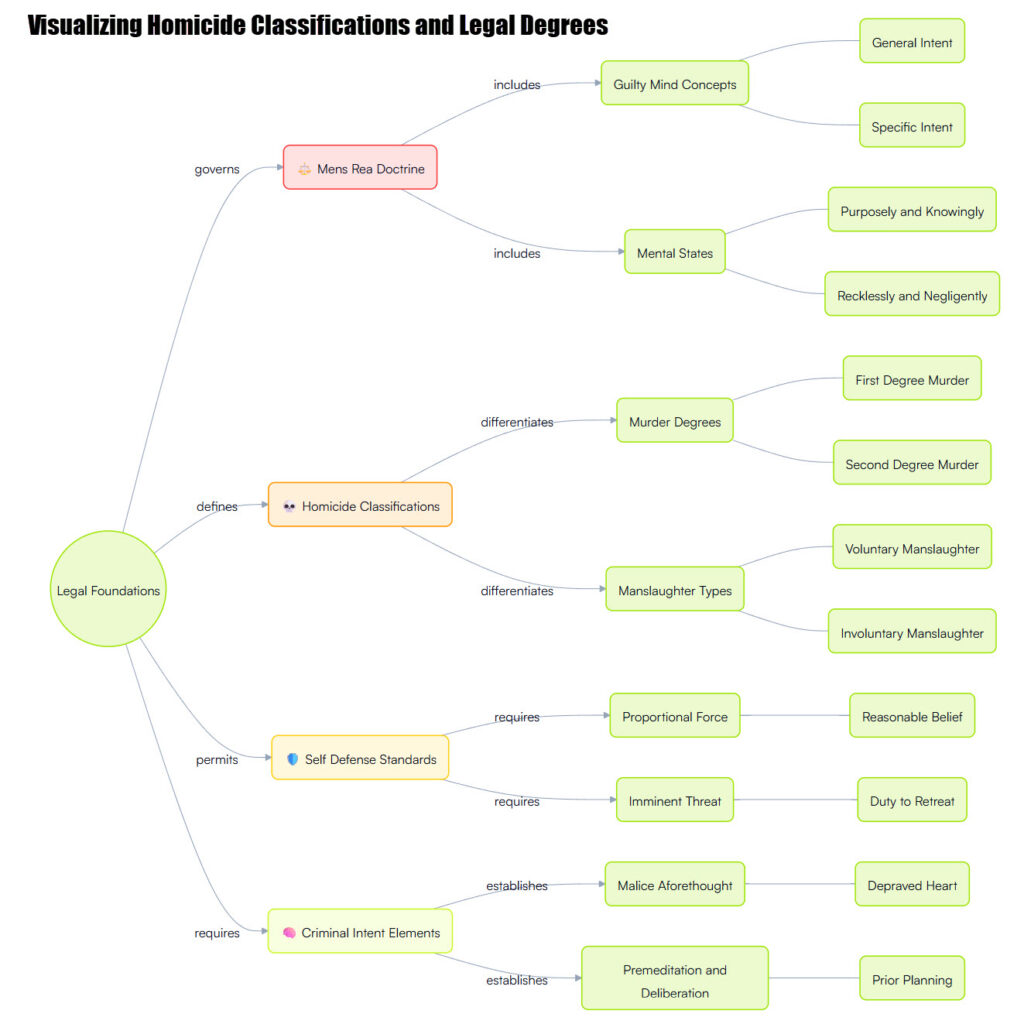
In homicide cases, intent plays a big role. Intent means “purpose” or “mindset.” This decides if the act is murder or manslaughter. Criminal law uses “mens rea,” which is Latin for “guilty mind.” For example, someone who plans and executes a killing has high intent—this could be first-degree murder.
Defining Murder and Its Degrees

Murder is the intentional killing of another person. It can be divided into different degrees, each with its own level of severity and intent….
Definition of Murder
Murder is the intentional killing of another person without legal justification. It involves malice aforethought, meaning there was a deliberate intention to kill.
Murder charges are categorized into degrees.
For example, first-degree murder requires premeditation—the killer planned it ahead of time. Second-degree murder lacks this planning but still involves intent to kill or cause severe harm.
Both forms result in severe penalties and long prison sentences.
First Degree Murder
First-degree murder involves planning ahead. This type of murder is both intentional and premeditated. For example, a person who plots to kill someone and then carries out the plan commits first-degree murder.
The act must show clear intent and thought.
A conviction for first-degree murder comes with severe penalties. In many states, those found guilty face 25 years to life in prison without parole. Courts see this as the most serious form of homicide because of its cold-blooded nature and careful planning…
Next, we will look at second-degree murder and how it differs from first degree.
Exploring Manslaughter

Manslaughter involves killing someone without planning it ahead of time. The person didn’t mean to kill but still caused death through their actions or negligence.
Definition of Manslaughter
Manslaughter is an unplanned killing. It happens due to provocation, recklessness, negligence, or accident. Unlike murder, it does not involve a premeditated intent to kill.
There are three types of manslaughter: voluntary, involuntary, and vehicular. Voluntary manslaughter occurs in the heat of passion. Involuntary manslaughter results from reckless behavior or criminal negligence.
Vehicular manslaughter involves deaths caused by car accidents due to reckless driving or DUI (Driving Under Influence). Although less severe than murder charges, manslaughter still counts as a felony with serious penalties.
Voluntary Manslaughter
Voluntary manslaughter is often called a “crime of passion.” This happens when someone kills in the heat of emotion. The person acts right after being provoked, having no time to cool off.
For example, imagine a spouse finds their partner cheating and kills them in anger.
This type of killing is different from murder. It’s less planned and more impulsive. A road rage incident that ends with one driver killing another can be voluntary manslaughter.
Courts see this as serious but not as planned or cold-hearted as murder. Punishments can go up to 11 years in prison—showing the act’s severity while acknowledging its emotional roots.
Involuntary Manslaughter
Involuntary Manslaughter happens when someone dies because of reckless or criminally negligent behavior. There is no intention to kill, and there is no premeditation involved. Let’s say a builder ignores safety rules, and as a result, an accident happens that kills someone.
That could be involuntary manslaughter. The person did not mean for anyone to die but acted without care.
Involuntary Manslaughter can result in 2 to 4 years in prison. It’s different from murder where intention plays a key role. This type of crime includes scenarios like drunk driving accidents where the driver’s careless actions lead to death.
These acts are wrongful deaths caused by recklessness or failure to act responsibly.
Vehicular Manslaughter
Vehicular manslaughter happens when a driver kills someone due to illegal or careless driving. This can be a felony or misdemeanor, depending on how serious the case is. Felony vehicular manslaughter can lead to up to 10 years in prison.
A misdemeanor might result in up to one year behind bars.
Many incidents of vehicular manslaughter involve DUI, reckless driving, or traffic violations. Even unlicensed drivers causing fatal crashes may face charges. This type of crime highlights the dangers of unlawful actions on the road and their severe impacts….
Next, let’s explore what sets murder apart from manslaughter: Intent and State of Mind.
Distinctive Factors Between Murder and Manslaughter
Murder involves intent to kill or cause serious harm, while manslaughter often results from reckless behavior without the same level of intent. The mindset and circumstances surrounding each act play crucial roles in determining the classification between murder and manslaughter.

Intent and State of Mind
Intent and state of mind are key in classifying homicide cases. Murder involves intent or premeditation to kill, along with malice aforethought. This means the person planned the killing ahead of time and had a cruel mindset.
Manslaughter, on the other hand, often occurs without prior planning. It might happen due to provocation, recklessness, or negligence—like an accidental killing during a heated argument or car crash caused by careless driving.
Understanding these differences helps explain why murder carries harsher penalties than manslaughter.
Legal Consequences and Penalties for Murder and Manslaughter

Legal consequences for murder and manslaughter vary greatly. Penalties depend on the crime’s severity and specific circumstances.
Penalties for Murder
When you think about murder, the penalties are severe and vary depending on the degree. Here’s a breakdown of the penalties for each degree of murder:
| Type of Murder | Definition | Penalty |
|---|---|---|
| First-Degree Murder | Intentional and premeditated killing | 25 years to life in prison |
| Second-Degree Murder | Intentional killing without premeditation | 15 years to life in prison |
| Class A-1 Felony | All degrees of murder | 15 to 40 years or life without parole |
First-degree murder involves a lot of planning. The law views it as the most serious. The penalty reflects that with a minimum of 25 years in prison.
Second-degree murder, while intentional, lacks the premeditation. It carries a lesser but still severe penalty of 15 years to life.
All degrees of murder fall under Class A-1 felonies. This means offenders could face anywhere from 15 to 40 years or even life without parole.
Penalties for Manslaughter
Penalties for manslaughter can vary based on the type and circumstances surrounding the case. Below is a summary of the different penalties associated with various forms of manslaughter:
| Type of Manslaughter | Description | Penalty |
|---|---|---|
| Voluntary Manslaughter | A “crime of passion” committed in the heat of the moment. | Up to 11 years in prison. |
| Involuntary Manslaughter | No malice, intention, or premeditation involved. | 2 to 4 years in prison. |
| Felony Vehicular Manslaughter | Causing death while committing a felony with a vehicle. | Up to 10 years in prison. |
| Misdemeanor Vehicular Manslaughter | Causing death through negligent driving. | Up to one year in prison. |
Each type of manslaughter carries different legal consequences and penalties. Moving on, let’s discuss common defenses in homicide cases…
Common Defenses in Homicide Cases in Murder and Manslaughter

Self-defense is a major argument in homicide cases. Another common defense involves mental issues, like insanity.
Justifiable Killing or Self-Defense
Justifiable killing or self-defense can be a valid legal defense in homicide cases. To claim this, the person must show they faced an imminent threat. They must also prove that their response was reasonable and necessary to protect themselves.
In some states, “stand your ground” laws allow people to use deadly force without retreating first.
The duty to retreat applies in other states, meaning you should try to escape before using lethal force. If you don’t follow this rule, you might face murder charges despite claiming self-defense.
Each state has its own rules and interpretations on this matter…
Transitioning now into how heat of passion plays a role in these defenses…
Heat of Passion
Heat of passion is a key factor in voluntary manslaughter cases. It happens when someone kills another person after being provoked strongly. There is no time to cool off, like finding out about a cheating spouse and acting right away.
This strong emotion can lower the crime from murder to manslaughter. In these cases, the jury looks at how reasonable the anger was and if it would cause an average person to lose control.
Next, we will explore more about related defenses such as self-defense and insanity.
Conclusion

Understanding the differences between murder and manslaughter is crucial. Both involve killing, but the intent differs. Murder includes planning, while manslaughter often happens in a moment of rage or by accident.
The legal system punishes each type differently. Knowing these details helps protect your rights if facing such charges. Always seek expert legal advice for serious accusations like homicide.
Knowledge is power… Stay informed about your rights and responsibilities! This understanding can save lives and futures. Keep learning and stay safe!
FAQs
1. What is the difference between murder and manslaughter?
Murder involves intentional killing with malice aforethought, while manslaughter refers to a killing without premeditation or in the heat of passion.
2. How are degrees of murder classified?
Degrees of murder are classified based on intent and circumstances. First-degree murder includes premeditated killings, whereas second-degree involves spontaneous acts without planning.
3. Can you explain voluntary versus involuntary manslaughter?
Voluntary manslaughter occurs when someone kills in a sudden fit of rage or under extreme emotional disturbance. Involuntary manslaughter happens due to reckless actions or negligence that result in death.
4. Why is understanding these classifications important?
Understanding these classifications helps in grasping legal consequences and defenses available for each crime, in both murder and manslaughter cases. Thus ensuring justice aligns with the nature of the offense.