Contact us: ww@blogquizshop.com

Have you ever wondered why powerful leaders get assassinated? These tragic events often shake the world. They can change history in surprising ways. There have been some Infamous Assassinations, so what were the Motives Behind History’s Most Famous Cases? Let’s discuss and question.

For example, when President John F. Kennedy was killed, it was a shock around the globe. People wanted to know why it happened and how such an event could take place.

In this blog, we will look at some of history’s most infamous assassinations. We will explore the methods used and uncover the motives behind these shocking acts. You won’t believe some of the reasons behind them…

Keep reading to find out more!

Key Takeaways

  • Varied Methods: Assassins use guns, poison, bombs, and stabbing. Each method has its unique impact and challenges in preventing such acts.
  • Historical Impact: The deaths of leaders like Lincoln, Gandhi, and JFK changed history. These events often cause political shifts or social changes.
  • Strong Motives: Reasons for assassinations include ideological conflicts, political gain, revenge, or mental instability. Understanding these motives can give insight into the causes behind these tragic acts.
  • Security Changes: Major assassinations lead to tighter security measures to protect leaders better. For example, JFK’s death led to stricter Secret Service protocols.
  • Public Policy Influence: Events like Martin Luther King Jr.’s assassination pushed for important civil rights laws. Assassination often drives significant changes in government policies and societal reforms.

Infamous Assassinations in History

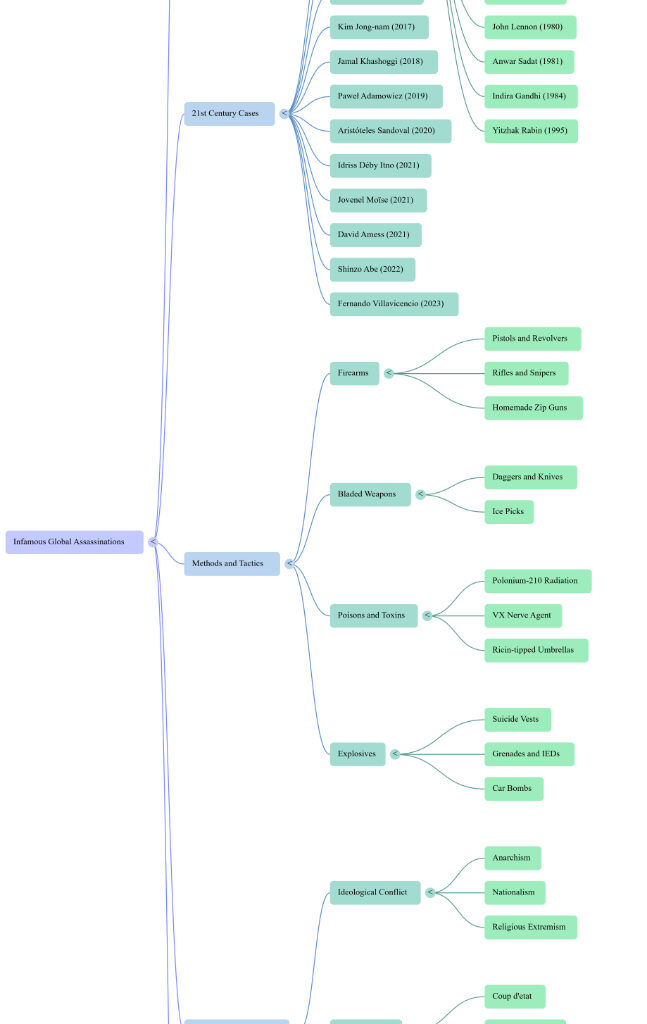
Assassinations have frequently reshaped political movements, national leadership, and public life by targeting individuals whose influence made them symbols of power or catalysts for change. Among the seven historically significant cases often studied are Julius Caesar, Abraham Lincoln, Archduke Franz Ferdinand, Mahatma Gandhi, John F. Kennedy, Martin Luther King Jr., and Indira Gandhi.

Despite being separated by centuries and vastly different political landscapes, these assassinations illustrate how such acts can stem from political rivalries, ideological extremism, nationalism, personal vendettas, or opposition to social reform. A comparative study of these events reveals that the motive behind an assassination is often of greater historical significance than the weapon or method employed.

The methods of assassination echo the volatile atmospheres and security landscapes of their times. In 44 BCE, the sharp glint of daggers flashed as Julius Caesar was brutally stabbed by a throng of Roman senators. Centuries later, in the dimly lit, echoing halls of Ford’s Theatre, Abraham Lincoln was felled by a sharp crack of John Wilkes Booth’s pistol in 1865. Sarajevo, 1914, was shattered by the percussive report of Gavrilo Princip’s firearm, striking down Archduke Franz Ferdinand – a single act igniting the smoldering tensions that would erupt into World War I.

The close-range roar of Nathuram Godse’s gun silenced Mahatma Gandhi in 1948, and in 1963, the sudden, horrifying gunfire ripped through the celebratory rumble of the Dallas motorcade, taking the life of John F. Kennedy. A year later, in 1968, the sudden violence found Martin Luther King Jr. as he stood outside his Memphis motel, the chilling sound of the shot piercing the night. In 1984, the cold betrayal of Indira Gandhi by her own bodyguards brought about her end. These stark events reveal a chilling pattern: assassins seizing upon the vulnerability of public life, the predictability of movement, the intimacy of proximity, or the chilling gaps in protective security.

The motivations and consequences behind these assassinations, however, varied greatly. Caesar’s conspirators asserted they were protecting the Roman Republic from unchecked individual power. Booth acted out of Confederate loyalty and opposition to Lincoln. Princip was linked to South Slav nationalist ambitions. Godse disagreed with Gandhi’s political strategies and his views on Hindu-Muslim relations in Partition-era India. While official investigations identified Lee Harvey Oswald as Kennedy’s assassin, his death sparked decades of debate and alternative theories.

King’s murder, on the other hand, occurred amidst fierce racial tensions and opposition to his civil rights leadership. Indira Gandhi’s assassination followed Operation Blue Star and was carried out by her Sikh security detail, leading to widespread anti-Sikh violence. Collectively, these assassinations illustrate that eliminating a prominent figure seldom dismantles the political forces associated with them; rather, it can create martyrs, exacerbate crises, deepen societal rifts, and shape history for years to come.

Let’s take a closer look at 7 infamous assassinations in history….

7 Infamous Assassinations

The Shocking Methods and Motives Behind History’s Most Famous Cases

Assassinations have rarely been ordinary murders. They are acts intended to eliminate a powerful symbol—and often to reshape politics, provoke upheaval, or send a warning. Here are seven cases whose methods and motives continue to fascinate historians.

1. Julius Caesar — Stabbed by His Allies

  • Date: March 15, 44 BCE

  • Method: Multiple conspirators stabbed Caesar in the Roman Senate.

  • Motive: Senators led by Marcus Junius Brutus and Gaius Cassius claimed that Caesar’s accumulation of power threatened the Roman Republic and was creating a monarchy. Approximately 60 conspirators were reportedly involved.

The killing was a spectacular betrayal: Caesar was attacked not by a foreign enemy but by members of Rome’s ruling elite. Instead of restoring the Republic, however, the assassination helped trigger civil wars that eventually brought imperial rule under Augustus.

 2. Abraham Lincoln — Murdered at the Theater

  • Date: April 14, 1865

  • Method: John Wilkes Booth shot Lincoln at Ford’s Theatre in Washington, D.C.

  • Motive: Booth was a Confederate sympathizer who blamed Lincoln for the Confederacy’s defeat and opposed the president’s plans for Reconstruction. The assassination formed part of a wider plot that also targeted Vice President Andrew Johnson and Secretary of State William Seward.

Booth exploited his familiarity with the theater to approach the presidential box. Lincoln died the following morning, just days after the effective collapse of the Confederacy, making the murder a violent attempt to disrupt the Union’s transition from war to peace.

Abraham Lincoln was the 16th President of the United States. John Wilkes Booth assassinated Lincoln on April 14, 1865. The event took place at Ford’s Theatre in Washington, D.C., during a play.

Lincoln was shot in the back of his head and died the next day.

Booth, an actor and Confederate sympathizer, thought killing Lincoln would help the South. But it did not change anything for them. He fled but was found twelve days later and killed on April 26, 1865.

This tragic act marked a dark moment in American history…

Next, we explore Archduke Franz Ferdinand and Gavrilo Princip.

 3. Franz Ferdinand — The Shot That Helped Ignite World War I

  • Date: June 28, 1914

  • Method: Gavrilo Princip shot Archduke Franz Ferdinand and his wife, Sophie, in Sarajevo with a pistol.

  • Motive: Princip was a South Slav nationalist who wanted to end Austro-Hungarian rule in the Balkans and help unite South Slav peoples in an independent state.

The assassination was the immediate spark for World War I, although the conflict also depended on deeper tensions, alliances, militarism, and imperial rivalry. Austria-Hungary used the killing as a pretext to confront Serbia, setting off a chain reaction across Europe.

Archduke Franz Ferdinand and Gavrilo Princip

Like  John Wilkes Booth killed Abraham Lincoln. This act shocked the world. Likewise, Gavrilo Princip‘s actions had global effects too.

On June 28, 1914, Archduke Franz Ferdinand was in Sarajevo. A young man named Gavrilo Princip shot him. Princip was part of the Black Hand society. His group wanted to free Serbs from Austro-Hungary rule.

The assassination sparked World War I and changed European history forever….

 4. Mahatma Gandhi — Killed by a Hindu Nationalist

  • Date: January 30, 1948

  • Method: Nathuram Godse approached Gandhi during a prayer meeting and shot him at close range with a small-caliber revolver.

  • Motive: Godse opposed Gandhi’s advocacy of Hindu-Muslim reconciliation and blamed him for what Godse regarded as concessions to Muslims during the violence and upheaval surrounding Partition. Godse described the murder in explicitly political terms.

Gandhi’s assassination shocked a newly independent India. It also demonstrated how a leader celebrated for nonviolence could become the target of an extremist who believed violence was necessary to defend his vision of the nation.

Mahatma Gandhi and Nathuram Godse

Nathuram Godse assassinated Mahatma Gandhi on January 30, 1948. Gandhi was a leader for peace and led India toward independence with nonviolence.

Godse disagreed with Gandhi’s methods and ideology. He thought Gandhi favored Muslims over Hindus during the partition of India. This extremist view drove him to kill the advocate for peace.

This assassination shook Indian politics and impacted India’s path forward, forever altering its history.

 5. John F. Kennedy — A Rifle Attack in Dallas

  • Date: November 22, 1963

  • Method: Kennedy was shot while traveling in a motorcade through Dallas. The Warren Commission concluded that Lee Harvey Oswald fired the shots from the Texas School Book Depository.

  • Motive: Oswald’s precise motive remains debated, though investigators examined his political history, personal grievances, and ideological sympathies.

Kennedy’s death became one of the most scrutinized events in modern history. The Warren Commission concluded that Oswald acted alone, while a later congressional committee found that Kennedy was probably killed as a result of a conspiracy but could not identify another gunman or establish the conspiracy’s extent.

John F. Kennedy and Lee Harvey Oswald

JFK, the 35th President of the United States, was shot on November 22, 1963. This tragic event occurred at 12:30 PM in Dallas.

Lee Harvey Oswald was accused of assassinating Kennedy with three shots. Police arrested him by 1:45 PM and arraigned him at 1:30 AM on November 23. Jack Ruby then shot Oswald on November 24, eliminating any chance for a trial.

Kennedy’s death shocked the nation and led to countless conspiracy theories. The Warren Commission investigated but concluded that Oswald acted alone.

 6. Georgi Markov — The “Umbrella” Poisoning

  • Date: September 1978

  • Method: Bulgarian dissident and writer Georgi Markov was poisoned with ricin, apparently injected into his leg by a device concealed in an umbrella.bbc+1

  • Motive: Markov had become a prominent critic of Bulgaria’s communist regime through broadcasts and writing. Investigators believed the killing was retaliation for his anti-communist work and linked the operation to Bulgarian state security, with possible assistance from Soviet intelligence.saturdayeveningpost

The case became infamous because the weapon appeared so innocuous. More broadly, it illustrated how state-sponsored assassinations could be designed not only to kill but also to intimidate dissidents far beyond a regime’s borders.


7. Indira Gandhi — Assassinated by Her Own Guards

  • Date: October 31, 1984

  • Method: Indian Prime Minister Indira Gandhi was shot by two of her Sikh bodyguards.

  • Motive: The attackers sought revenge for the Indian army’s assault on the Golden Temple in Amritsar, a major Sikh religious site, earlier that year.historyextra

The killing was especially shocking because the assassins belonged to Gandhi’s personal security detail. Her death was followed by widespread anti-Sikh violence, showing how an assassination can unleash consequences far beyond the intended target.

Why These Cases Endured

These assassinations became historically important because each removed—or attempted to remove—a figure who represented a larger political order:

  • Caesar represented the struggle between republican government and personal rule.

  • Lincoln embodied the Union’s victory and the uncertain aftermath of civil war.

  • Franz Ferdinand became the trigger for a crisis that engulfed Europe.

  • Gandhi symbolized religious reconciliation and nonviolent politics.

  • Kennedy’s murder intensified public distrust and conspiracy theories.

  • Markov’s death exposed the reach of secret-police tactics.

  • Indira Gandhi’s assassination revealed the dangers of political and religious polarization.

The methods varied from knives and pistols to a disguised poison device, but the underlying pattern was similar: the assassin sought to turn one person’s death into a political message.

Why infamous assassinations gives such outsized staying power, rather than just being a violent crime that fades from memory.

The figure as symbol, not just individual

In each case, the victim wasn’t just a person with a title — they’d come to embody a fault line already running through their society:

  • Franz Ferdinand stood for the fragile multi-ethnic order of Austria-Hungary and the entire alliance structure of pre-war Europe. Killing him didn’t just remove a man; it detonated a system that was already under tension.
  • Caesar represented the question of whether Rome would remain a republic or become something else. The conspirators thought killing the man would preserve the order — instead, removing him proved the republic couldn’t survive the vacuum.
  • Gandhi embodied a vision of pluralist, nonviolent India at the exact moment that vision was being tested by Partition violence. Godse wasn’t just killing a man; he was attacking what Gandhi stood for.
  • MLK and Malcolm X each represented a strategic and moral argument about how Black liberation should proceed. Their deaths didn’t resolve those arguments — they intensified them.
  • Sadat personified the idea that peace with Israel was possible and legitimate. Killing him was an attack on that possibility itself.
  • Rabin was, at the moment of his death, the personal guarantor of the Oslo process. There was no one else who could carry both the security establishment’s trust and the diplomatic commitment.

Why this makes the act generative rather than just destructive

When you kill a symbol, you don’t erase what it stood for — you create a rupture that forces everyone else to react to the absence. That’s why these events don’t just cause grief; they cause realignment:

  • Supporters often become more committed, not less (martyrdom effect)
  • Opponents can overreach in the aftermath, discrediting themselves
  • Institutions or movements that depended on that one figure’s authority fracture or radicalize
  • The assassin’s own cause frequently backfires — Godse wanted a more militant Hindu nationalism, and got decades of Gandhi’s near-canonization instead

The exception that proves the rule

It’s worth noting: assassinations of figures who didn’t represent a broader order tend to vanish from history relatively quickly. There’s no shortage of killed monarchs, generals, or officials whose deaths caused a succession crisis and then were forgotten within a generation. What separates the ones on this list is that the political or ideological fault line survived the person — so the assassination became a permanent reference point in an ongoing argument, not a closed chapter.

Want to dig into a specific mechanism — like how martyrdom effects get manufactured or resisted (compare Gandhi’s near-instant sanctification vs. how contested Malcolm X’s legacy remained), or how power-vacuum dynamics differ between authoritarian systems (Caesar) and democratic ones (Rabin, Sadat)?

Key Methods Used in Infamous Assassinations

key methods used in infamous assassinations 321209640

Assassins have used varied techniques to achieve their deadly goals. These methods reveal much about the motives and planning behind these actions….

Firearms

Firearms have played a key role in many assassinations. John Wilkes Booth used a gun to kill Abraham Lincoln on April 14, 1865. Booth shot Lincoln at close range during a play at Ford’s Theatre.

firearms 321209168

Lee Harvey Oswald is accused of using a rifle to assassinate President John F. Kennedy. This tragic event happened on November 22, 1963, in Dallas, Texas. Oswald fired three shots from a nearby building and changed history forever with his act.

Poisonpoison 321209842

Poison has been a stealthy tool in many assassinations. Alexander Litvinenko, a Russian defector, was poisoned with polonium-210 in 2006. This rare and highly toxic substance led to his slow and painful death.

He had accused the Russian government of murder before he died.

Another case of poison-related assassination is James A. Garfield’s story. Although shot, he didn’t die from the bullets directly. His wounds became infected, leading to fatal blood poisoning or sepsis due to poor medical care at that time in 1881.

Slow poisoning can be an invisible assassin, said Dr. John Smith, a toxicology expert.

Using poisons like these shows how silently deadly substances can change history through their lethal power.

Explosivesexplosives 321209136

Explosives have been a deadly method in many infamous assassinations. Rajiv Gandhi, the former Prime Minister of India, died in 1991. A suicide bomber from the Tamil Tigers killed him during an election campaign.

This event shocked the world and showed how dangerous explosives can be.

Suicide attacks are not the only way explosives are used. Terrorists often use remote detonation to target political figures. Improvised explosive devices (IEDs) are common tools for these plots.

These methods make it hard to predict and prevent such deadly explosions.

Stabbingstabbing 321209931

Explosives can be loud and devastating, but another common method is much quieter—stabbing. This method often involves a knife or dagger. It requires close contact with the target, making it very personal and direct.

Many infamous crimes used stabbing. Julius Caesar’s assassination involved multiple stabbings from his own senators. Each stab wound was an act of betrayal from those he trusted most.

Stabbing continues to be a grim reminder of how brutal human actions can be in moments of violence and murder.

Other Infamous Assassination Cases and Their Impact

famous assassination cases and their impact 321209225

Infamous Assassination Cases and Their Impact:

These shocking incidents shook the world, changing the course of history forever… curious to know more?

Many assassinations, beyond those already covered, have profoundly impacted national politics, deepened societal rifts, and transformed personal tragedies into enduring public legacies. These instances highlight how the repercussions of political murder frequently ripple far beyond the victim’s demise.

The history of assassination is not limited to presidents and wartime leaders; some killings have instigated coups or wars, while others have reshaped social movements, influenced election outcomes, or led societies to question accountability.

Martin Luther King Jr. — 1968

  • Method: King was shot while standing outside his motel room in Memphis, Tennessee.

  • Motive: James Earl Ray was convicted of the murder, although debate over the case has continued for decades.

  • Impact: King’s assassination triggered riots and unrest in more than 100 American cities. It also weakened the momentum of the Poor People’s Campaign and contributed to a harsher political climate surrounding Black activism.

For many Americans, the killing seemed to challenge the possibility that nonviolent protest could achieve racial justice. Congress nevertheless passed the Fair Housing Act shortly afterward, giving the tragedy an immediate legislative consequence.

Malcolm X — 1965

  • Method: Malcolm X was shot while preparing to speak at the Audubon Ballroom in New York City.

  • Motive: His public break with the Nation of Islam created bitter hostility, and members of the organization were convicted of the murder. However, later investigations found that two of the three men convicted had been wrongfully imprisoned; both were exonerated in 2021.

  • Impact: Malcolm X’s death strengthened his status as a symbol of Black nationalism, self-defense, and political independence. His ideas continued to influence the Black Power movement and later generations of activists.

The unresolved questions surrounding the case also made his assassination an enduring subject of legal and historical investigation.

William McKinley — 1901

  • Method: Anarchist Leon Czolgosz shot President McKinley at the Pan-American Exposition in Buffalo, New York. McKinley died eight days later.

  • Motive: Czolgosz identified with anarchist opposition to government and concentrated economic power, though he acted alone.

  • Impact: Vice President Theodore Roosevelt became president, bringing a younger and more reform-minded leader to the White House. The assassination also helped expand the role of the U.S. Secret Service in protecting presidents and presidential candidates.

The case illustrates how an assassin’s personal ideology can unexpectedly change the direction of a country’s government.


Leon Trotsky — 1940

  • Method: Ramón Mercader, a Spanish communist and suspected Soviet agent, fatally attacked Trotsky with an ice pick at Trotsky’s home in Mexico. Trotsky died the next day.

  • Motive: Trotsky had become Joseph Stalin’s most prominent ideological and political rival. He had been expelled from the Soviet Union and continued criticizing Stalin from exile.

  • Impact: Trotsky’s death removed a major opponent of Stalinism and reinforced the reach—and the fear—associated with Soviet political repression. It also transformed Trotsky into a lasting symbol for anti-Stalinist Marxists.

The attack followed an earlier machine-gun assault on Trotsky’s home, showing that exile did not necessarily provide protection from state-directed violence.

Yitzhak Rabin — 1995

  • Method: Israeli Prime Minister Yitzhak Rabin was shot after addressing a peace rally in Tel Aviv.

  • Motive: The assassin, Yigal Amir, was an Israeli Jewish extremist who opposed Rabin’s negotiations and agreements with the Palestine Liberation Organization.

  • Impact: Rabin’s death weakened Israel’s peace camp and deepened political polarization over the Oslo process. It became a powerful warning about the danger of extremist opposition within a democratic society.

Rabin’s assassination is especially significant because it was not carried out by a foreign enemy or an underground revolutionary group, but by a citizen who wanted to stop his own government’s policy.

Benazir Bhutto — 2007

  • Method: Bhutto was assassinated while campaigning for parliamentary elections in Pakistan; the attack involved gunfire and a suicide bombing.

  • Motive: The attack was widely associated with militant opposition to Bhutto and her Pakistan People’s Party, although responsibility and the precise chain of command remained disputed.

  • Impact: Her death destabilized Pakistan during an already tense political transition. It also elevated her martyr-like status within the Pakistan People’s Party and helped her widower, Asif Ali Zardari, and her party gain political momentum.

Bhutto’s assassination showed how electoral politics can become especially vulnerable when democratic institutions operate alongside militant violence.

Shinzo Abe — 2022

  • Method: Former Japanese Prime Minister Shinzo Abe was shot while delivering a campaign speech in Nara. Police arrested the attacker at the scene.

  • Motive: Investigators reported that the suspect was angry about his mother’s financial donations to a religious organization that he believed had connections to Abe.

  • Impact: Abe’s assassination shocked Japan, a country with relatively low levels of political violence. It prompted scrutiny of security arrangements, political relationships with religious groups, and the influence of Abe’s legacy on Japan’s conservative political movement.

Unlike many historic assassinations, the attack did not arise from a conventional revolutionary program. Its reported motive was intensely personal, but its consequences were national and political.

Patrice Lumumba — 1961

Patrice Lumumba, the first prime minister of the newly independent Democratic Republic of the Congo, was executed by a firing squad in January 1961 after being transferred to Katanga, a secessionist region. Belgian officials and Katangan authorities were present, and the circumstances were concealed for years.

Lumumba’s death became a defining symbol of Cold War interference and postcolonial struggle. His removal helped clear the way for the rise of Joseph-Désiré Mobutu, whose long authoritarian rule profoundly shaped Congolese history.

Sheikh Mujibur Rahman — 1975

Bangladesh’s founding leader, Sheikh Mujibur Rahman, was assassinated during a military coup on August 15, 1975. Most of his family were also killed, while rival factions within the armed forces struggled for control.

The assassination ended Bangladesh’s first post-independence political era and ushered in years of coups, military influence, and political instability. Mujib later became a central figure in Bangladesh’s national memory, with his legacy remaining highly influential—and politically contested.

Robert F. Kennedy — 1968

U.S. Senator Robert F. Kennedy was fatally shot in Los Angeles shortly after winning the California Democratic presidential primary. Sirhan Sirhan was convicted, although questions about the evidence and the possibility of additional involvement have persisted.

Kennedy’s death changed the 1968 presidential campaign at a moment of extraordinary national tension. Coming only months after Martin Luther King Jr.’s assassination, it deepened public anxiety and removed a candidate who had represented, to many supporters, a possible alternative to the country’s growing polarization.

Harvey Milk — 1978

Harvey Milk, one of the first openly gay elected officials in the United States, was murdered alongside San Francisco Mayor George Moscone by former city supervisor Dan White. The killings followed political disagreements and intense conflict over city policy.

Milk’s assassination made him an international symbol of LGBTQ+ political representation. The lenient sentence given to White provoked the “White Night” riots and intensified demands for equal treatment under the law.

Anwar Sadat — 1981

Egyptian President Anwar Sadat was assassinated during a military parade by Islamist militants opposed to his government and its peace treaty with Israel. The attack took place in front of a large public audience and shocked the Middle East.

Sadat’s death did not reverse the peace treaty. Instead, Vice President Hosni Mubarak succeeded him and maintained the agreement, while Egypt adopted tighter internal security measures. The killing nevertheless demonstrated the danger faced by leaders who make diplomatic compromises opposed by powerful ideological movements.

John Lennon — 1980

John Lennon was shot outside his New York apartment by Mark David Chapman, who had developed an obsessive fixation on the musician. Although Lennon was not a head of state, his worldwide fame and political activism led many people to describe the murder as an assassination in the broader cultural sense.

The impact was immediate and global: fans gathered for vigils, Lennon’s music acquired an even more solemn cultural status, and the murder intensified debates about celebrity, mental illness, gun access, and public security. It also showed that symbolic figures outside formal politics could become targets whose deaths reverberated internationally.

What These Cases Reveal

These assassinations produced several recurring effects:

  • Leadership changes: McKinley’s death elevated Theodore Roosevelt, while Bhutto’s assassination reshaped Pakistan’s political succession.

  • Movement symbolism: King, Malcolm X, and Trotsky became enduring symbols whose influence continued after death.

  • Political polarization: Rabin’s murder and King’s assassination intensified existing divisions.

  • Security changes: McKinley’s killing helped expand protective measures for American political leaders.

  • Public distrust: Unresolved evidence, disputed motives, and alleged conspiracies often make assassinations persist in public memory long after official investigations end.

An assassination may be planned to silence one person, but it frequently does the opposite: it turns the victim into a symbol and gives the underlying conflict a much longer life.

The Wider Pattern

These cases reveal several recurring consequences:

  • Succession: Philip II’s death placed Alexander on the throne and changed the history of the ancient world.

  • Foreign intervention: Lumumba’s murder became inseparable from Cold War politics and colonial legacies.

  • Coups and instability: The deaths of Mujibur Rahman and other national leaders created power vacuums exploited by military factions.

  • Movement symbolism: Milk, Kennedy, and Lennon became larger cultural symbols after their deaths.

  • Security and polarization: High-profile assassinations frequently lead to tighter protection, harsher laws, and deeper political distrust.

An assassination may remove a person, but it rarely removes the conflict surrounding that person. More often, the victim’s death becomes a rallying point, a source of political legitimacy, or a permanent national grievance.

Motives Behind Political Assassinations

motives behind political assassinations 321209620

Motives Behind Political Assassinations: People often kill leaders for many reasons—some want power, while others seek revenge or have strong beliefs. Discover more about what drives these acts….

Ideological Conflicts

Many assassinations stem from strong beliefs. John Wilkes Booth, a Southern supporter, hated Abraham Lincoln’s views on slavery. He planned to kidnap Lincoln first but later decided to kill him at Ford’s Theatre in 1865.

Other killers also had extreme ideologies. Nathuram Godse opposed Mahatma Gandhi’s calls for peace between Hindus and Muslims. In 1948, he shot Gandhi in New Delhi. These acts show how deep political conflicts can drive people to violent acts…even murder.

Political Gain

Political gain often drives assassinations. Leaders may be seen as obstacles to a group’s goals. Gavrilo Princip killed Archduke Franz Ferdinand in 1914 for this reason. He hoped the death would help the Black Hand society.

Princip’s act led to World War I, changing world politics forever. Assassins see their actions as ways to bring about desired political changes quickly… even if it means using violence.

Political killings are extreme measures but have shaped history significantly.

Revenge

Some assassinations stem from revenge. People seek retribution for wrongs, real or perceived. This motive often involves a personal grudge or vendetta… like settling scores. Lee Harvey Oswald’s reasons for killing JFK still spark debate.

Some think he had deep personal grievances.

Revenge can drive people to extreme actions. It’s a powerful feeling that blinds logic and fuels retributive justice—making it deadly in politics. Events like these show how dangerous and impactful seeking payback can be on a grand scale.

Mental Instability

Mental instability can drive people to commit shocking acts. Charles J. Guiteau is one example. On July 2, 1881, he shot President James A. Garfield. Later, people found out that Guiteau had mental health issues.

Psychiatric instability can lead someone to take extreme actions they would not usually consider. These unstable minds often see violence as their only option for change or attention…

This connects well with the next topic: “The Global Repercussions of Assassinations.

The Global Repercussions of Infamous Assassinations

the global repercussions of assassinations 321209219

Assassinations can shake the world… They often lead to increased security measures and political instability.

Global Repercussions of Infamous Assassinations

Assassinations of political leaders have catalyzed wars, regime transitions, and shifts in international norms across more than a century of recorded history. Scholarly evidence—spanning datasets from 1875 to 2024—shows that these events produce heterogeneous institutional, conflict-related, and geopolitical consequences that vary by target type, regime context, and the presence of succession mechanisms.

Institutional and Regime Consequences

Successful assassinations of autocrats produce sustained moves toward democracy, while the intensity of small-scale conflicts also shifts in the wake of leader killings. In repressive regimes, the most authoritarian states are the most likely to experience political institutional shifts following terrorist assassinations, though the direction of those shifts is mixed. The type of assassination target—whether a head of state or a lower-ranking official—shapes whether significant institutional change follows.

Regime Context Key Finding Caveat
Autocracies Successful assassinations produce sustained democratic transitions Effects vary by target type
Repressive regimes Most repressive states most likely to shift institutionally Direction of shift is mixed
Systems with informal succession Assassinations’ destabilizing effects are greatest Formal succession mechanisms buffer impact

Domestic Instability and Conflict Escalation

Assassinations significantly increase the likelihood of coups, revolutions, and civil wars within the targeted state. The sudden removal of a central authority figure produces a crisis that can embolden dissatisfied groups to push for political change through violent means. Political assassinations during civil war also significantly decrease voter turnout in both the short and medium terms, with effects persisting even after peace agreements.

International and Geopolitical Repercussions

  • The assassination of Archduke Franz Ferdinand illustrates how a single leader’s killing can trigger dramatic international consequences, including world war.
  • Assassination of a state leader may be viewed by international rivals as an opportune time for invasion, linking leader killings to interstate conflict.
  • Western-state assassinations of Third World liberation leaders from the 1960s onward altered the course of history across Africa and the Middle East, weakening political organizations and contributing to fragmented, leaderless opposition movements.
  • The 2020 assassination of Iranian General Soleimani extended targeted-killing practices into inter-state relations, eroding the international norm against assassination.

Targeted Killings and Counterterrorism Backfire

The killing of Osama bin Laden did not produce the desired deterrent effect on global terrorism; instead, it coincided with a global increase in terrorist fatalities in many countries, including some with previously declining trajectories. Targeted killings of high-profile terrorist leaders may rally support for the global jihadist base rather than diminishing it, with evidence of null or backlash effects across multiple studies. Despite this lack of empirical support for deterrence, targeted killings continue to be touted as counterterrorism successes even before their impacts can be observed.

Targeted Killing Claim Empirical Finding  
Bin Laden killing deters terrorism No deterrent impact; global fatalities increased  
Removing leaders weakens organizations Killings may rally support for jihadist base  
Targeted killings reduce attack lethality Evidence shows increased lethality post-killing  

Economic and Corporate Spillovers

Assassinations of activists in the global mining sector produce substantial financial consequences for connected multinational firms, with named companies experiencing large negative abnormal returns and a median loss in market capitalization of approximately 100 million USD. 

The media plays a crucial role in amplifying these effects: the negative impact is strongest when assassinations coincide with calm news cycles rather than peak cycles dominated by large international stories. Activist assassinations are also positively related to the royalties paid by mining projects to domestic governments, suggesting institutional ripple effects beyond the immediate corporate sphere.

Normative Erosion and Covert Practice

State-sponsored assassination, reframed as “targeted killing” in the war on terrorism, is undergoing a normalization process that has facilitated the extension of these techniques from counterterrorism contexts into inter-state relations. Covert assassination operations by the US government historically employed varying degrees of remoteness to achieve political objectives while maintaining deniability and avoiding escalation, as seen in cases from Lumumba to Fadlallah. 

Assassinations and targeted killings beyond recognized battlefields permit governments to pursue foreign policy objectives and deploy violence in the absence of direct confrontation and beyond the reach of public and parliamentary scrutiny.

The evidence collectively demonstrates that infamous assassinations generate repercussions across institutional, conflict, economic, and normative dimensions, but these effects are neither uniform nor universally in the direction intended by perpetrators—democratic transitions, backlash violence, norm erosion, and financial market shocks can all follow from a single act.

Changes in Security Protocols

Governments use tighter security after major infamous assassinations. Guards and surveillance help protect leaders from harm or threats. For example, the assassination of John F. Kennedy in 1963 led to strict measures by the Secret Service.

New protocols include advanced background checks and metal detectors at events. These steps aim to prevent access for dangerous people and ensure leader safety. This keeps security breaches in check…but political turmoil can still occur.

– Political Turmoil and Shifts

Political Turmoil and Shifts

Assassinations often lead to political turmoil and shifts. The assassination of Archduke Franz Ferdinand in 1914 triggered World War I, causing massive upheaval. This act led to the fall of empires and a big shake-up in global politics.

Abraham Lincoln’s assassination in 1865 had huge effects on post-Civil War America. It plunged the nation into more chaos when it needed stability most. Such events show how killing a leader can change everything—sometimes even leading to regime change or government overthrow…and almost always sparking civil unrest.

Influence on Public Policy

Political assassinations often lead to major changes in public policy. When JFK was killed in 1963, the U.S. greatly increased security for presidents. This change aimed to protect leaders from future threats.

The assassination of Martin Luther King Jr. in 1968 had a big impact on civil rights policies and movements. It pushed lawmakers to pass laws that promoted equality and justice for all Americans.

These events show how tragic actions can drive important changes in government policies and society as a whole.

infamous assassinations

Institutional resilience after political assassinations

Institutional resilience after political assassination events varies substantially across regime types, succession structures, and the nature of the target, with formalized mechanisms for leadership turnover consistently buffering against instability while informal succession systems amplify destabilizing effects.

Succession Mechanisms and Stability

The presence of a regularized, institutionalized means of leadership succession both assuages citizens’ concerns over regime continuity and reduces or eliminates the opportunity for dissident groups to seize power by force. Conversely, systems in which leadership succession occurs through internal struggle or guile are substantially more likely to experience unrest, because the assassination creates a power vacuum not immediately filled through institutional channels.

Assassinations’ effects on political instability are greatest in systems where the process of leadership succession is informal and unregulated, while the adverse effects are generally assuaged by the presence of a standardized means for succession. Clear designation of a successor—defined as appointment of a “second-in-command”—prevents unbridled power struggle among ruling elites and grooms the successor, thereby neutralizing succession’s destabilizing electoral impact in authoritarian regimes.

Succession Context Resilience Outcome Mechanism
Formal, regularized succession Instability muted Institutional channels fill vacuum
Informal, unregulated succession Instability greatest Power vacuum invites factional violence
Clear successor designation (autocracies) Electoral impact neutralized Prevents elite power struggle

Regime Type and Institutional Change

Successful assassinations of autocrats produce, on average, sustained moves toward democracy, documenting a contemporary source of institutional change. The most repressive regimes are the most likely to experience political institutional shifts following terrorist assassinations, though the direction of those shifts is mixed and depends on the level of state repression prior to the event.

Democratization following an autocratic leader’s assassination may paradoxically facilitate domestic upheaval, as previously disenfranchised groups seek representation or power. The type of assassination target—head of state versus lower-ranking officials—determines whether significant institutional change follows, with outcomes differing across authoritarian, mixed, and democratic regimes.

Democratic Resilience Factors

  • Democracies with strong judicial constraints on the executive are more resilient to autocratization onset.
  • Past institutional strength predicts resilience, but economic development is associated only with resilience to onset, not against breakdown once autocratization has begun.
  • Democratic resilience encompasses the ability to withstand, adapt, or recover without losing constitutive core institutions, organizations, and processes.
  • In hybrid and sectarian regimes like Lebanon, elite survival has relied on patronage networks and strategic recalibration of power structures across crises, reinforcing rather than transforming institutions.

Local Orders and Post-Conflict Assassination

Assassinations of social leaders in post-conflict Colombia are more likely and more frequent in municipalities with intermediate party fragmentation and low voter turnout, reflecting restricted electoral competition where local elites sustain competitive authoritarian orders.

A higher share of votes for leftist parties—signaling challengers to local elites—correlates with higher probability and greater numbers of assassinations, indicating that local political orders shape micro-dynamics of repression. Electoral competition in nonliberal, polarized settings creates incentives for incumbents to find alternative ways to block opposition, including the utilization of assassinations.

Public Attitudes and Emotional Resilience

  • The 2024 attempted assassination of Donald Trump did not escalate partisan tensions; Republicans became significantly less supportive of partisan violence and showed increased in-party attachment.
  • Extreme acts of political violence can promote in-group solidarity without increasing tolerance for violence against the opposing party.
  • Political leaders regulate collective emotional resilience through discursive-moral regulation, shaping public emotional stability via moral and rhetorical governance after crisis events .
  • Community resilience after political violence is supported by rebuilding social structures, reopening schools and workplaces, and instituting communal accountability mechanisms such as tribunals and truth commissions.

Institutional resilience after assassinations is thus not a fixed property of regimes but a conditional outcome shaped by the interplay of formal succession rules, regime type, target characteristics, local political orders, and the discursive and social resources mobilized in the aftermath.

Conclusion

conclusion 321209880

These infamous assassinations changed history forever. From Lincoln to Gandhi, each death had big impacts. The methods used—guns, poison, bombs—reveal the lengths people will go to for power or beliefs.

Understanding these motives helps us see why they happened and what lessons we can learn. Learning about these tragic events shows how important strong leadership and understanding are in our world.

Stay curious… let this knowledge inspire change!

FAQs

1. What are some of the most infamous assassinations in history?

Some of the most infamous assassinations include those of Julius Caesar, Abraham Lincoln, John F. Kennedy, and Archduke Franz Ferdinand.

2. What methods were used in these famous assassination cases?

Various methods were employed—stabbing for Julius Caesar, shooting for Abraham Lincoln and John F. Kennedy, and a bomb attack for Archduke Franz Ferdinand.

3. Why did people commit these shocking acts?

Motives varied greatly: political power struggles drove many like Caesar’s murder; personal vendettas or ideological reasons motivated others like those behind JFK’s assassination.

4. How do we study historical assassinations today?

Experts use forensic analysis, historical documents, eyewitness accounts—and modern technology—to piece together the events and understand their broader impacts on history.

7 Infamous Assassinations and The Shocking Methods generated pin 35921

pinit fg en round red 32
Shopping Basket