Beyond the Pedals: 5 Surprising Secrets to Transforming Your Ride (and Your Brain)
1. The Plateau Problem: Why “More Miles” is a Performance Trap
We’ve all been there: grinding through a Sunday century only to realize your legs feel like lead and your PRs are ancient history. You’re putting in the work, yet your speed stagnates and that “post-ride glow” starts to feel more like a chore. This is the classic Plateau Problem. The endurance world is haunted by the myth that more volume always equals more progress, but as a performance strategist, I’m here to let you in on a secret: cycling isn’t just a cardio grind; it’s a sophisticated physiological hack. To break the cycle of “junk miles,” you have to stop chasing distance and start mastering the science of the ride.
2. The 21.6% Advantage: Why Your Brain Craves the “Frontal Lobe Shift”
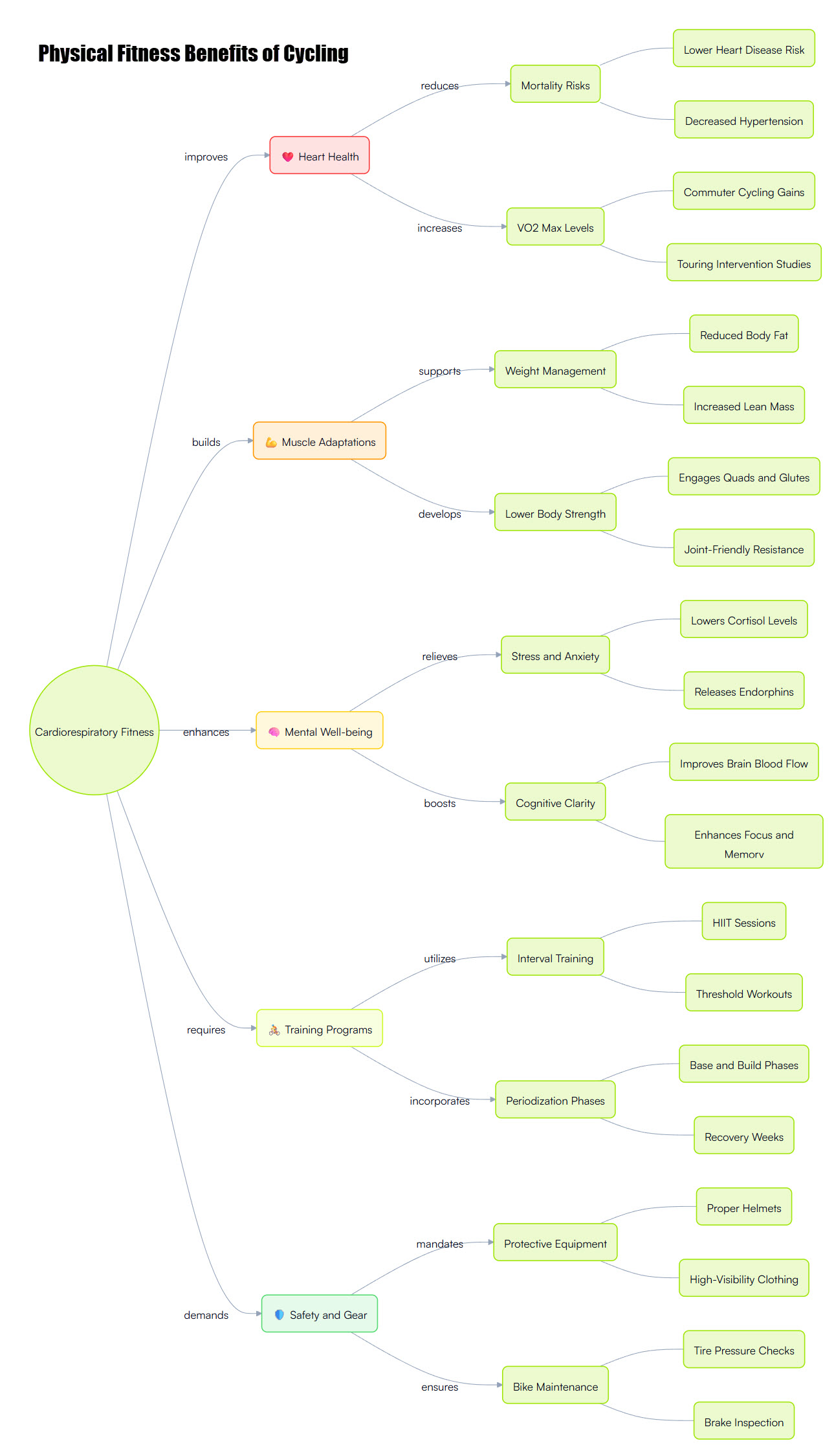
Cycling is one of the most potent mental health tools ever studied, ranking second only to team sports in emotional effectiveness. Groundbreaking Oxford University research involving 1.2 million participants revealed that cyclists suffer 21.6% fewer days of poor mental health per month than non-exercisers. But the benefits aren’t just mental; according to a meta-analysis of 2.6 million participants, recreational cycling also delivers a 20% reduction in cardiovascular mortality.
The magic happens during a “goal-focused” brain shift. When you’re pushing into those higher power zones, blood flow is diverted to the frontal lobes—the brain’s decision-making and control center. This physiological redirect silences the “hamster wheel” of your internal monologue, effectively shutting down the noise of daily stress.
“By putting more focus and attention into the goal-directed parts of the brain, you may be removing some of the effort from other parts… it could fit in with that subjective sense that by putting more effort into meeting a particular goal in cycling, you find that more relaxing.” — Professor John Geddes, Head of Psychiatry, Oxford University
3. The Efficiency Paradox: Why 30 Seconds Beats the Long Grind
While the “long, steady grind” has its place, the real gains are hidden in short, sharp bursts of suffering. Research shows that just eight weeks of active-travel cycling can lead to a 13.8% VO2 max increase in males. To unlock this, we look to the Hormetic response—the biological phenomenon where short-term, extreme stress triggers a massive adaptive recovery.
While 10-to-40-second maximum efforts are great for burning fat and spiking power, the “gold standard” for elite gains often lies in the 4-to-8-minute interval block. This is where the highest “gain-to-pain” ratio lives.
The 30/30 Performance Powerhouse A favorite in the pro-toolkit is the 30/30 configuration: 30 seconds of maximum, “toss-your-cookies” effort followed by 30 seconds of easy recovery. Repeat this 10 to 15 times. It’s a time-efficient way to skyrocket your cardiovascular ceiling without the mental burnout of a four-hour slog.
4. Technical Mastery: The “Push-Pull” Secret and the Resistance Rule
Speed is a mechanical game. If you’re only pushing down on the pedals, you’re leaving power on the table and risking your joints. “Spinning circles” is the pro way: you must master the “pull-up” on the back half of the stroke to fully engage your quads and glutes while keeping your feet flat.
Furthermore, many beginners ruin their knees by riding with too little resistance. If you’re “bouncing in the saddle,” you aren’t working—you’re just jarring your joints. Adding resistance provides the tension necessary to stabilize the knee. And a quick tip for the workshop: the left-hand pedal features a reverse thread (turn it right to loosen). Knowing this prevents the heartbreak of a stripped crank arm.
“Always make sure you have enough resistance on… protect your knees. If you find you’re bouncing in the saddle, turn it up. Work on building the muscles, and the speed will come.” — Kaleigh Cohen, Indoor Cycling Specialist
5. The Glycogen Gamble: When to Feast and When to Fast
To master metabolic flexibility, you have to time your carbs. Consuming a big bowl of pasta right before a low-intensity ride actually “blunts” your body’s ability to oxidize fat for fuel. Instead, pros use a strategy called “Train High, Sleep Low.” This involves a high-intensity session late in the day with full fuel, then—and here is the “torture” part—going to bed without refueling to keep glycogen levels low. You then perform a fasted, low-intensity ride the next morning.
This forces your body to become a fat-burning machine. However, don’t confuse training with racing. For long-haul performance, “bonking” (a catastrophic blood sugar drop) is the enemy. On big ride days, eating every 30 minutes is the golden rule.
The Fat-Burner’s Pantry (Pre-Ride):
- Poached or scrambled eggs
- High-quality protein bars (low sugar)
- “Bulletproof” coffee (brewed coffee with healthy fats)
6. The “Goldilocks” Zone: Training for the 100,000 km Game
The “sweet spot” for lifelong fitness is 3 to 5 sessions per week, clocking in at about 45 minutes each. To avoid the dreaded burnout, never increase your weekly volume by more than 10%. But consistency isn’t just about the numbers; it’s about the “discoverability” of the ride. As mountain bikers know, “riding somewhere different” is the ultimate driver of long-term motivation.
Cycling is a long-game sport. There’s a saying among veteran roadies that it takes 100,000 km before you truly understand the bike. Embrace the process, chase the variety, and let the odometer climb naturally.
7. Conclusion: The Long Road Ahead
Cycling is your science-backed shortcut to a stronger body and a quieter mind, but only if you stop “slugging” through mindless miles. By embracing the Hormetic stress of intervals, mastering the push-pull mechanics, and strategically managing your glycogen, you turn every ride into a masterclass in performance.
Next time you clip in, ask yourself: Will you be chasing mindless miles, or will you be chasing the 30-second burst that unlocks your brain’s quietest moment?


 Cart is empty