To understand why we still count like Caesars, we have to look past the seven letters we learned in grade school. Here are five counter-intuitive secrets that prove Roman numerals are much more than just “fancy letters.”
1. The “V” and “L” Are Literally Half-Sized
We often view Roman numerals as independent letters, but they originated from a deeply intuitive physical logic of “ranks” and “halves.” The symbols for 5, 50, and 500 weren’t arbitrary choices; they were designed to be literal halves of the larger symbols that followed them.
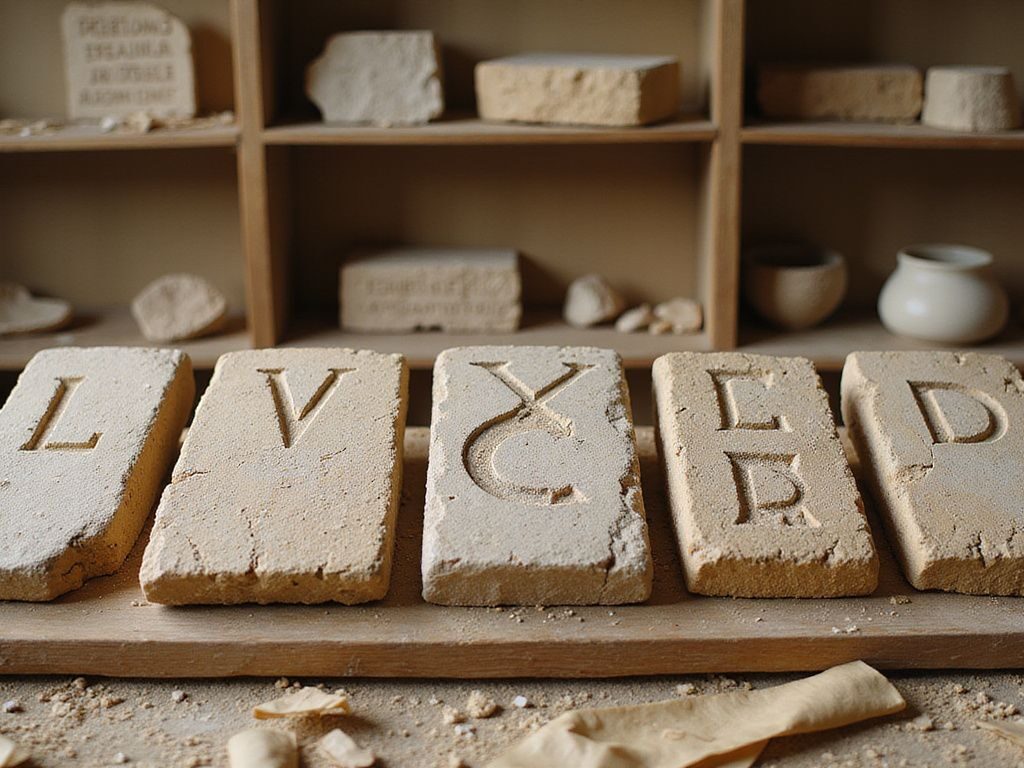
In this system, the X (10) is what historians call a “second rank” symbol. If you split an X horizontally, the bottom half forms a V (5). This logic extends upward: the early symbol for 100 was a “third rank” mark resembling a curved asterisk or a multi-stroke hash. When that symbol was cut in half, it eventually evolved into the L (50) we recognize today. Even the D (500) follows suit—it began as the right-hand half of the early symbol for 1,000 (a circle split by a vertical line).
This explains why the origin of these symbols is likely singular rather than a hodgepodge of different ideas. As the scholars at latintutorial point out, we should lean on “Occam’s Razor”—or as the Romans might say, numquam est ponenda pluralitas sine necessitate—which suggests that the simplest explanation is usually the right one. In this case, the V, L, and D aren’t unique characters; they are simply the halfway marks to the next major rank.
2. The Romans Were “Subtractive” Rule-Breakers
Modern classrooms teach a very strict version of Roman numerals: you must write 4 as IV (5 minus 1) and never as IIII. We are told that repeating a symbol four times is a cardinal sin of notation. The Romans, however, were remarkably flexible “rule-breakers.”
To the ancient mind, addition and subtraction were often interchangeable. If you walk past Gate 44 of the Colosseum, you won’t see a perfectly “standard” modern number. Instead, you’ll see the inscription XLIIII. Here, the scribe used the subtractive XL for 40, but then immediately switched to the additive IIII for the final digit.
This proves that the system was a “living” convention rather than a set of hard mathematical laws. This ancient flexibility survives on the faces of high-end analog clocks today, which often use IIII instead of IV—a nod to a time when clarity and local custom were more important than rigid standardization.
3. The Letter “M” is a Middle-Ages “Modernization”
If you asked a Roman in the era of Augustus (around 1 AD) for the symbol for 1,000, they wouldn’t have written the letter M. In the early Empire, 1,000 was represented by a variety of symbols, including a circle with a vertical line or a set of “rotated crosshairs” that looked like a horizontal figure-eight or an infinity symbol.
The use of the letter M didn’t become the standard until the Middle Ages. It was adopted largely because of the Latin word mille (thousand), providing a convenient shorthand for a symbol that had become difficult to carve or write quickly.
Era and Convention | Notation and Symbols |
|---|
Early Roman (Augustus-era 1,000) | Circle with a vertical line or rotated crosshairs |
Early Roman (Halved for 500) | D with a horizontal bar |
Early Roman (Third-rank 100) | Curved asterisk or multi-stroke hash mark |
Modern (Post-Middle Ages) | Standardized letters M, D, and C |
4. The Zero-Shaped Hole in History
Perhaps the most famous “failure” of the Roman system is the complete absence of a symbol for zero. This wasn’t an oversight; it was a philosophical choice. The Romans used their numerals for counting tangible assets—bags of grain, head of cattle, or legionnaires. If you had no sheep, you didn’t need a symbol to tally them; you simply had “none.”
When they needed to express the concept of nothingness in writing, they used the word “nulla”. While this worked for basic inventory, it created a massive “arithmetic ceiling.” Without a zero to act as a placeholder, complex mathematics like large-scale multiplication and division became nearly impossible to perform on paper. This technical limitation is precisely why Europe eventually traded the Roman system for Hindu-Arabic numerals for calculation, leaving Roman symbols for the world of titles and monuments.
5. Fractions Were Counted by Twelve, Not Ten
While the Roman system for whole numbers was decimal (base-10), their fraction system was “duodecimal” (base-12). This was a stroke of practical brilliance. In a pre-digital world, dividing things into thirds and fourths was essential for trade. Using a base of 10 makes this messy (1/3 of 10 is a repeating 3.33), but a base of 12 is elegantly divisible: 1/3 of 12 is a clean 4, and 1/4 is a clean 3.
To record these fractions, the Romans used a specialized notation:
- S (standing for semis, or half) represented six-twelfths.
- Dots (•) represented individual twelfths.
To write a number like 4.5, a Roman wouldn’t use a decimal point; they would write IV S. It was a sophisticated solution for the marketplace, proving that while their system struggled with abstract higher math, it was perfectly tuned for the practical realities of a merchant’s stall.
Conclusion: The Gravitas of the Past
Over the centuries, Roman numerals shifted from a clunky accounting tool to a symbol of tradition and authority. We don’t use them today because they are efficient—we use them because they carry the weight of history. They provide a sense of “gravitas” that modern digits, for all their utility, simply cannot match.
The next time you see a movie’s copyright year or the name of a monarch like King Charles III, ask yourself: Are we choosing these symbols because they are clear, or because they remind us of an empire that refused to be forgotten?


 Cart is empty