Weight training, or resistance training, challenges muscles against external resistance. The resistance may come from barbells, dumbbells, kettlebells, machines, bands, body weight, or suspension equipment. Repeated muscular contractions create a training stimulus that can improve strength, hypertrophy, power, muscular endurance, balance, and core stability.
Weight training supports different goals through changes in exercise selection and programming. Heavy, low-repetition training emphasizes maximal strength, moderate-to-high volume supports muscle growth, and circuit or high-intensity training can increase energy expenditure and muscular endurance. The same exercise can therefore produce different outcomes depending on load, volume, rest, frequency, effort, and progression.
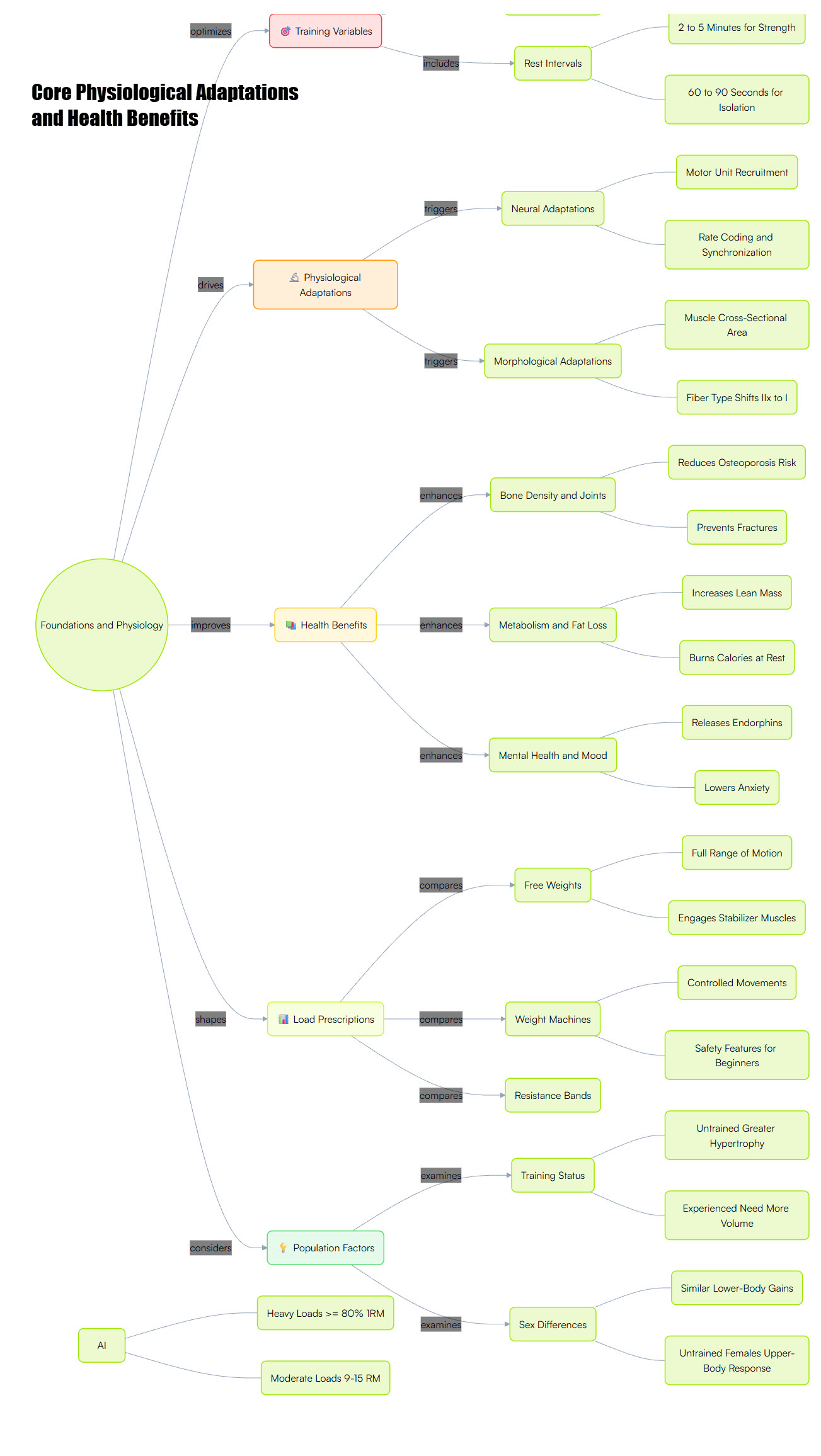
Load describes the resistance used relative to an individual’s one-repetition maximum, or 1RM. Loads of at least 80% 1RM generally produce the greatest improvements in tested maximal strength because they expose the nervous system and muscles to high force demands. Moderate loads of approximately 9 to 15RM via Weights can also improve strength and may be more tolerable for people who cannot safely use very heavy resistance.
Sets, repetitions, frequency, rest intervals, and exercise order via Weights determine how much useful work a person can perform. Multiple sets usually outperform a single set, while training a movement or muscle group at least twice per week provides a practical foundation for progress. Rest periods of 2 to 5 minutes are appropriate when maximal strength and power are the priority. Large-muscle, multi-joint exercises such as squats, deadlifts, presses, and rows generally come before smaller isolation exercises so fatigue does not reduce performance on the main lifts.
Hypertrophy is less dependent on a single load range which could be via Weights or other techniques, than maximal strength. Similar muscle growth can occur across a broad range of loads when sets are performed with sufficient effort and adequate weekly volume. Higher volumes, often 10 or more sets per muscle group per week, and eccentric overload may provide additional hypertrophic stimulus. Training to momentary muscular failure is not consistently necessary, particularly when it causes excessive fatigue or compromises technique.
Early strength gains are driven substantially by neural adaptations. The nervous system becomes better at recruiting motor units, increasing their firing rate, coordinating their timing, and directing force toward the intended movement. These changes can improve performance before substantial muscle growth occurs. Electromyographic activity, including EMG amplitude, may reflect changes in neural drive, although the response varies with training experience and contraction type.
Morphological adaptations become increasingly important as training continues. Muscle fibers can enlarge, increasing muscle cross-sectional area and force-producing potential. Changes in pennation angle may allow more contractile tissue to be arranged within a muscle, while shifts in fiber characteristics, including movement from Type IIx toward Type I and Type IIa profiles, reflect adaptation to repeated training demands. Strength development is therefore the result of both improved neural control and changes in muscle structure.
Resistance exercise, for example via Weights, activates cellular pathways involved in repair and growth. Mechanical tension and muscle damage-related signals can activate satellite cells, which support muscle repair and remodeling. The mTOR signaling pathway helps regulate muscle protein synthesis when training is combined with adequate protein, energy, and recovery. Muscle growth occurs between training sessions as tissues repair and adapt, not during the lifting session itself.
Resistance training increases or preserves lean mass, which can improve body composition and increase resting energy expenditure. A reported average response to regular training was a 1.06 kg increase in lean mass, or approximately 1.9%, alongside an 11% improvement in bench press performance. High Frequency Training produced a reported 21% improvement in hack squat performance. These figures are averages and vary according to training status, nutrition, age, sex, adherence, and measurement methods.
Fat loss depends primarily on sustained energy balance, although resistance training helps preserve muscle during a calorie deficit. Squat training at 60 to 80% 1RM reduced body fat percentage over six weeks in one example, while progressive bodyweight squats improved strength and hypertrophy without producing significant fat loss. Combining resistance and aerobic exercise can reduce body weight and body fat while maintaining or improving strength. A modest calorie deficit, high protein intake, and progressive lifting are more sustainable than relying on exercise alone.
Weight training produces benefits beyond appearance. Mechanical loading via Weights, stimulates bone remodeling and can increase or preserve bone mass, helping reduce the risk associated with osteoporosis and age-related fracture. Stronger muscles also improve balance, joint support, and the ability to manage everyday physical tasks. Proper technique, gradual progression, and appropriate exercise selection are necessary because poor mechanics or excessive loading can increase injury risk.
Increased muscle mass supports glucose disposal and metabolic health. Regular resistance training can help regulate blood sugar, reduce obesity risk, and contribute to lower risks of diabetes and cardiovascular disease. It may also reduce visceral fat, the metabolically active fat stored around internal organs. Weight training should complement, rather than replace, aerobic activity, balanced nutrition, and medical care when health conditions are present.

Mental health benefits may result from physiological, psychological, and behavioral effects. Exercise can stimulate endorphin release, reduce anxiety, improve mood, and strengthen self-esteem and body image. Via Weights adolescents aged 10 to 16 have also shown increased self-worth in association with weight-training programs. Consistent completion of challenging but manageable workouts can create a sense of competence and control, although resistance training should not be treated as a substitute for professional mental-health treatment.
Via Weights males and females generally achieve similar hypertrophy and lower-body strength gains when training is appropriately prescribed. Untrained individuals often experience faster initial growth because they are highly responsive to a new stimulus. Previously trained individuals may require more weekly sessions or volume to continue progressing. Weaker athletes should generally establish a strength base before emphasizing high-velocity power training.
The most effective program is individualized. Load should match the goal, volume should match recovery capacity, frequency should permit consistent practice, and exercise selection should reflect the person’s equipment, abilities, preferences, and movement demands. Free weights and machines can both produce substantial improvements in muscle and strength, while bands and bodyweight exercises provide accessible alternatives. A sustainable plan performed consistently is more valuable than an advanced plan that cannot be recovered from or maintained.
All resistance modalities create adaptation through the same broad sequence: external resistance via Weights creates muscular tension, tension requires motor-unit recruitment, repeated exposure stimulates neural and structural changes, and recovery allows those changes to consolidate. The equipment changes the movement constraints, force direction, stability demands, and skill requirements. It does not automatically determine whether strength or hypertrophy will occur.
Training outcomes are shaped by load, effort, range of motion, volume, frequency, and progression. When these factors are reasonably matched, free weights and machines generally produce comparable muscle growth and similar improvements on neutral strength tests. The main differences appear in movement specificity, balance, stabilization, accessibility, and the demands placed on technique.
Free weights allow the lifter to control the resistance through multiple degrees of freedom. Dumbbells, barbells, and kettlebells require force production while the body stabilizes the load and coordinates the movement path. This greater freedom can increase demands on balance, trunk control, and smaller stabilizing muscles, particularly during squats, lunges, presses, and rows.
The adaptation process begins with learning to coordinate the movement and maintain posture. As technique improves, the lifter can apply force more efficiently and progressively increase load. Free-weight training may therefore improve balance, functional performance, and isometric hip-abductor and hip-extensor strength more than machine training in some populations. These advantages are most relevant when the goal involves controlling an unconstrained object or producing force during complex athletic or daily-life movements.
Free weights do not guarantee faster overall strength or hypertrophy gains. Their effectiveness depends on appropriate programming and execution. Free-weight exercises can also have a higher technical and safety demand, making lighter starting loads, spotters, racks, or coaching useful for beginners.
Machines constrain the movement path and often stabilize part of the body. This reduces the need to balance the resistance and allows the user to focus more directly on producing force with the target muscles. Guided movement can make machines useful for beginners, people managing fatigue, and individuals who need a controlled range of motion.
The process is comparatively simple: set the seat and resistance, select a manageable load, perform the prescribed movement through the available range, and increase resistance when technique remains consistent. Machines can support substantial gains in upper-arm, thigh, chest, and other muscle areas. Novice trainees can achieve strength and muscularity improvements similar to those produced by free weights when the program provides sufficient effort and progression.
Machine training may transfer less effectively to tasks requiring balance and independent control because the machine supplies some of the stability. This is not a disadvantage when the goal is targeted hypertrophy, local muscle loading, rehabilitation, or safe training with limited technical complexity. Machine strength can also be specific to the machine’s angle, handles, leverage, and range of motion.
Bands create resistance through elastic tension, which generally increases as the band is stretched. This produces a different resistance curve from many free weights, where external load is more consistently determined by gravity. Band exercises can be anchored, held, or looped around the limbs to perform presses, curls, squats, rows, clamshells, and rehabilitation movements.
Band training develops strength when the resistance is sufficiently challenging and the exercise is performed through an appropriate range of motion. A 2019 study reported strength gains similar to those achieved with free weights or machines. Bands are especially useful for home workouts, travel, warm-ups, and physical therapy because they are lightweight, inexpensive, and available in multiple resistance levels.
The main limitation is practical loading via Weights. It can be difficult to quantify exact resistance, progressively overload certain exercises, or maintain high tension at every point in a movement. Progression can still occur by using a thicker band, increasing stretch length, changing the anchor position, adding repetitions or sets, slowing the tempo, or selecting a harder variation. Pain or instability in a rehabilitation setting requires guidance from an appropriately qualified professional.
The SAID principle means Specific Adaptations to Imposed Demands. The body adapts most strongly to the movements, joint positions, contraction types, force directions, speeds, and equipment used during training. Consequently, strength measured on a free-weight exercise tends to improve more after free-weight training, while strength measured on a particular machine tends to improve more after training on that machine.
Research illustrates this pattern. Machine-trained groups have shown larger improvements on machine-specific pressing tests, while free-weight squat training has shown greater transfer to jumping than leg-press training. A free-weight group can develop more balance and control because the training task requires those abilities. However, differences often become smaller when strength is tested on a neutral movement or when overall volume and effort are matched.
Transfer should therefore be judged against the target task. Athletes should include movements that resemble their sport’s force direction, speed, stability, and coordination demands. General muscle growth can be achieved with either machines or free weights, while functional performance may benefit from including free-weight or other unconstrained movements alongside targeted machine work.
Equipment choice should match the goal, training environment, skill level, and recovery needs. Free weights are useful for multi-joint strength, balance, and broad movement practice. Machines are useful for controlled loading, beginner confidence, targeted muscle work, and periods when stabilization is limited. Bands are useful when portability, low cost, variable resistance, or rehabilitation access is the priority.
A mixed approach often provides the broadest solution. A beginner might learn squatting and pressing with a machine or light dumbbells, add bands for warm-up and accessory work, and gradually incorporate more demanding free-weight exercises. An experienced trainee might use barbells for primary lifts, machines for hypertrophy volume, and bands for travel or joint-friendly accessory training. Since research generally finds comparable overall hypertrophy and general strength, adherence and goal-specific transfer should guide the final decision.
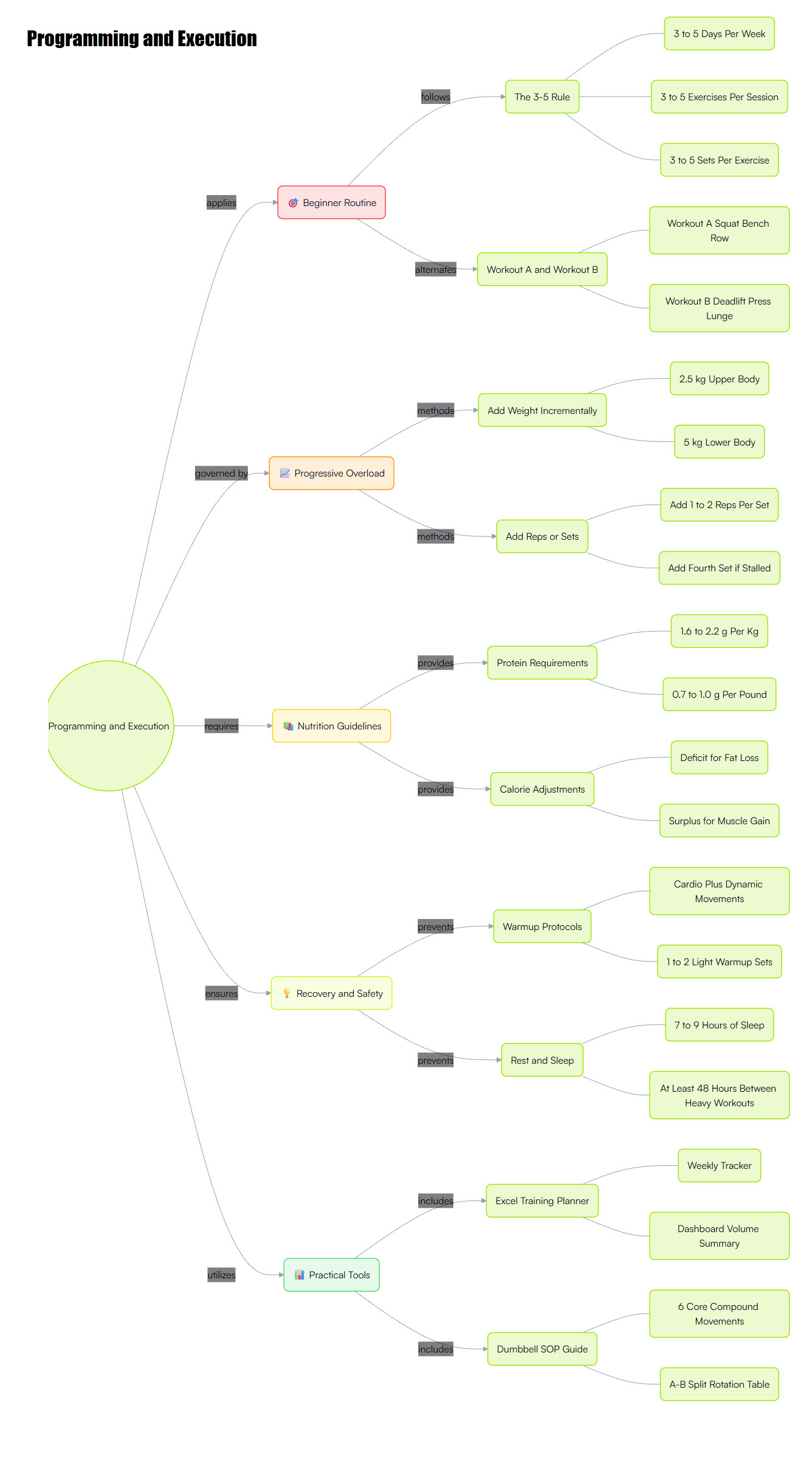
The 3-5 rule provides a simple structure for a beginner routine: train 3 to 5 days per week, perform 3 to 5 exercises per session, and complete 3 to 5 sets per exercise. It is a guideline rather than a requirement. A three-day full-body program using three sets per movement is often sufficient for steady progress without excessive fatigue.
Workout A may include a squat, bench press or push-up, row, Romanian deadlift, and plank. Workout B may include a deadlift, overhead press, lat pulldown or assisted pull-up, split squat or lunge, and farmer’s carry. Alternate the sessions across the week, such as Monday A, Wednesday B, and Friday A, then begin the following week with B.
Progress only after the current workload can be completed with controlled technique. A common increment is approximately 2.5 kg for upper-body lifts and 5 kg for lower-body lifts. If adding weight would cause form breakdown, add 1 to 2 repetitions per set until the upper end of the target range is reached, then increase the load and return to the lower end.
Adding a fourth set can help when progress stalls, but volume should increase gradually. Record exercise, load, sets, repetitions, RPE, and rest duration in a notebook or app. A practical decision rule is to increase load when RPE is 8 or lower and rest remains within the plan, repeat the load when RPE reaches approximately 8.5 to 9 or rest becomes excessive, and reduce or deload when RPE reaches 9.5 or higher.
Begin with 5 to 8 minutes of easy cardio followed by dynamic movements such as leg swings, arm circles, bodyweight squats, and hip hinges. Perform one or two light warm-up sets before the first demanding lift. Dynamic preparation should raise body temperature and rehearse the movement without creating fatigue.
Technique has priority over load. Maintain a braced trunk, controlled tempo, stable joint positions, and a range of motion that can be performed without pain. Beginners may benefit from qualified coaching for squats, deadlifts, presses, rows, and Romanian deadlifts. Start with lighter weights and, when learning unfamiliar movements, use approximately 12 to 15 comfortable repetitions before progressing toward heavier strength-focused work.
Rest 2 to 5 minutes between heavy strength or power sets when maximal performance is the priority. Rest approximately 90 to 180 seconds for heavy compound lifts and 60 to 90 seconds for smaller or isolation exercises in general fitness programming. Muscle recovery may require about 24 hours after light training and 48 hours or more after demanding full-body or high-intensity sessions.
Sleep supports tissue repair, nervous-system recovery, and body-composition change. A target of 7 to 9 hours per night is appropriate for most adults, with greater needs possible after intense training. Light walking, mobility work, and recreational activity can support recovery on nonlifting days. Persistent pain, worsening performance, or repeated form breakdown signals the need to reduce training stress and seek professional assessment when appropriate.
Training supplies the stimulus, while nutrition supplies energy and amino acids for adaptation. A daily protein intake of approximately 1.6 to 2.2 g per kg of body weight, or about 0.7 to 1.0 g per pound, supports muscle repair and growth. Emphasize lean proteins, vegetables, fruit, whole grains, healthy fats, and adequate fluids while limiting excessive alcohol and highly processed foods.
For fat loss with strength retention, use a modest calorie deficit of approximately 200 to 400 kcal below maintenance while maintaining high protein and progressive resistance training. For maximizing muscle gain, use a modest surplus of approximately 200 to 300 kcal above maintenance. Body-composition results depend on adherence, starting condition, training status, sleep, and the duration of the program.
Proper form, gradual loading, adequate warm-up, and recovery reduce injury risk. Beginning with excessive weight can cause technique failure, delayed-onset muscle soreness, muscular imbalance, or acute strain. At least 48 hours between demanding full-body sessions is a useful starting point, although recovery needs differ by exercise intensity, training age, sleep, nutrition, and health status.
Short sessions can still be effective when they cover major movement patterns and are performed consistently. A 20-minute dumbbell routine can use an A/B split, with three movements per session, two sets of 10 repetitions, and approximately 60 seconds of rest, allowing all major patterns to be trained across the week. Long-term results come from repeatable sessions, measurable progression, sufficient protein and energy, and the willingness to adjust training when recovery or technique declines.